The short answer
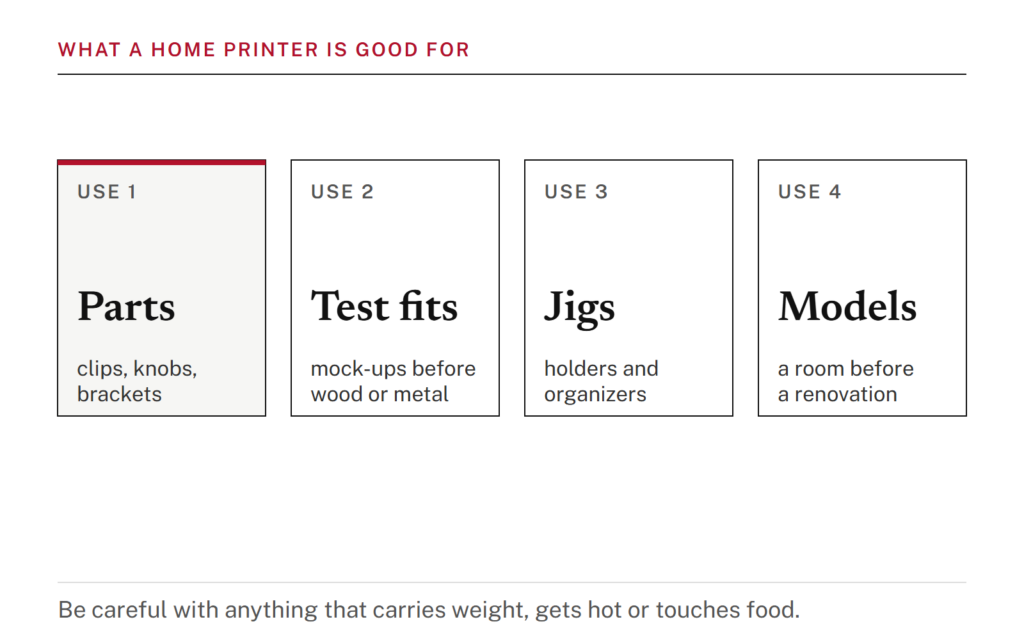
- The dependable home uses are replacement parts, test fits and prototypes, simple tools and organizers, and models.
- 3D printing makes the most sense for one-offs and small runs, where a mold or a custom order would cost more than the part is worth.
- Anything that carries weight, gets hot, touches food or protects someone needs extra care, or should be bought rather than printed.
The plastic clip that holds the dishwasher’s top rack snaps, the maker no longer sells it, and nothing at the hardware store fits. That is the kind of small, awkward problem a home 3D printer is good at, and it is a better guide to what the machine is for than a shelf of novelty figures.
Spare parts and small repairs
The strongest everyday use is the part nobody sells any more. Ultimaker, a printer maker, describes the factory version: a worn or discontinued part can be reprinted and back in service within hours. The household version is the same idea at a smaller scale: a knob, a clip, a bracket, a cap or a gear.
How-To Geek writer Joe Fedewa describes a case close to the dishwasher clip. His IKEA cabinet came with supports for only three shelves, the maker does not sell more, and his fix was to print his own.
Prototypes and test fits
3D printing grew out of rapid prototyping, and it is still good at it. HP, which sells industrial printers, says a working prototype can arrive within days of the first idea, and that it can even be made in the final material so a design can be evaluated and tested more fully. At home that means printing a cheap mock-up of a shelf bracket or a box lid to check the fit before committing to wood or metal, though a hobby print is no substitute for a real test.
Tools, jigs and organizers
University of Tennessee Libraries report that requests to their library makerspace range from bicycle racks for a garage wall to custom lab equipment. In a home workshop the equivalents are a guide for drilling at a fixed angle, a holder that keeps a part still while glue sets, or a rack made for exactly the tools you own. Drawer dividers and cable organizers belong here too, because the whole point is that they are made to the size of your drawer or desk.
How-To Geek’s Fedewa shows the same pattern in prints he modeled himself: a hook that supports a long closet rod and a drip tray that lets water flow out of a hanging plant without taking the plant out of its macrame holder.
Models and teaching aids
Printed models show up in hospitals, dental offices and classrooms. Mayo Clinic’s news network describes surgeons who used a printed model to prepare for removing a rare tumor, and says patients who see a true-to-anatomy model of their own insides often understand better what the operation will involve. It also lists the drawbacks: printing models takes time and can cost a lot. The American Dental Association says a dental office can add a 3D printer to its digital workflow to make diagnostic models, occlusal guards and surgical guides.
In education, University of Tennessee Libraries describe printing dinosaur bone and pollen grain models for the McClung Museum, and I-beam models that construction science classes used to find out which design holds up best under load. Scaled down, that covers a model of a room before a renovation, a puzzle for a class, or a plastic version of a shape that is hard to describe in words.
One-offs and small batches
Most plastic products are made by injection molding, which Ultimaker says becomes cost effective only after a lot of parts, because the initial mold takes much longer to make. Printing fills the gap when you need only a handful or a single custom piece. HP lists small production runs, custom one-offs and spare parts among the uses, and its short answer to what additive manufacturing can make is almost anything. A personalized gift or a part sized to your own appliance fits that pattern.
That is a vendor’s answer. At home, the realistic answer is smaller and more specific, and it depends on your printer, your material and how much care you put into the design.
Where to be careful
A printed part is only as strong as its material and design, and a hobby printer’s plastic has limits. Anything that carries a person’s weight, gets hot, touches food or protects someone from harm needs the right material and a proper design, or is better bought than printed. Start with parts where failure costs you a minute, not an injury.
A starter list
- A replacement knob, clip or cap for something you already own
- A wall hook or holder sized to the thing it holds
- Drawer dividers and a cable organizer
- A phone stand or a small shelf bracket
- A mock-up of something you plan to build in another material