The short answer
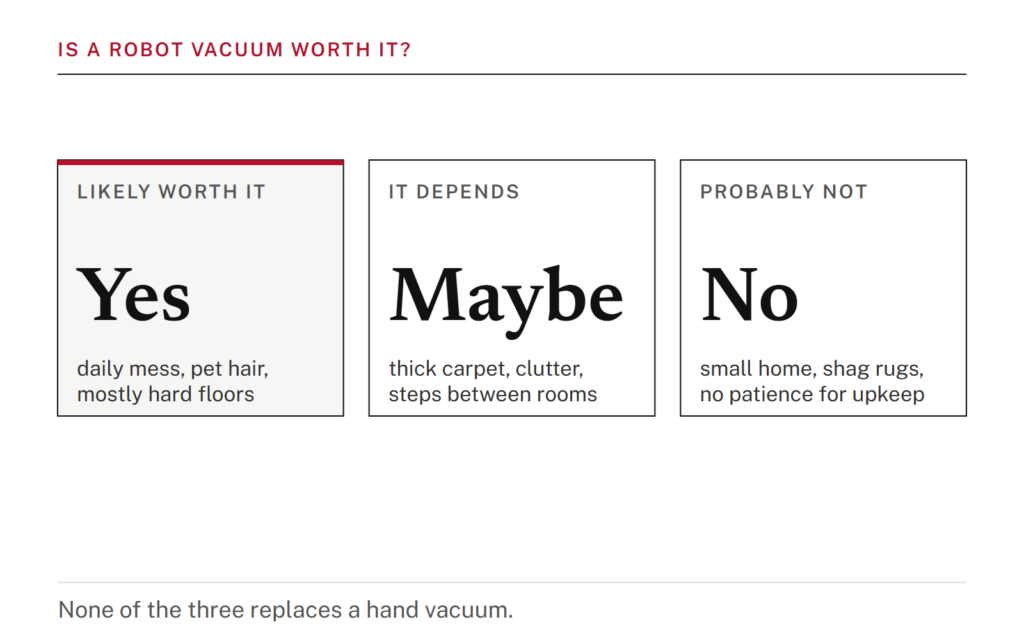
- A robot vacuum is worth it if you want the everyday floor mess handled without effort, especially with pets and mostly hard floors.
- It is a poor fit for a small home, shag rugs, or anyone who dislikes emptying bins and cutting hair off brushes, and a layout with steps and split levels is a maybe.
- It does not replace a hand vacuum, which still does the deep cleaning and everything above the floor.
It is Saturday morning, you are pushing a vacuum around the living room for the third weekend running, and a robot vacuum is open in a tab on your phone. Is it worth the money and the upkeep? The answer depends less on the robot than on your home and your habits.
Who gets the most out of one
The people who rave about robot vacuums tend to have the same kind of home: a lot of daily mess and floors the machine can cross easily. Wired’s reviewer, who has tested robot vacuums for eight years, runs hers every morning. Her argument is about consistency rather than perfection: she is content if it gets through 50 or 65 percent of the house, because some cleaning every day beats none.
CHOICE, an Australian consumer group with its own test lab, makes the same case for pet hair: on hard floors, its testers have found most robot vacuums do a good job, and it is easy to program them to run regularly. Its verdict is that a home with hard floors and heavy shedders could be a great place for one.
Ecovacs, a robot vacuum maker, argues the machines pay off mainly as everyday upkeep, above all in homes with shedding pets, allergy sufferers or heavy foot traffic, and notes that they get under furniture and into corners. Scheduling and remote control are part of the pitch, and they matter most to people with little time to spare.
An owner’s account makes the same point from the other side. Young House Love, a home blog, sold an early Roomba because it was loud, kept getting stuck and ran out of battery before covering much ground, later bought an entry-level slim model, and wrote that it now handles roughly 95% of the vacuuming at home. The blog puts the difference down to how far the technology has come.
Who will probably be disappointed
Wired’s reviewer lists four situations where a robot vacuum may not be worth it:
- A small home. If vacuuming takes an hour or so, there is little to save.
- A complicated layout. Her example is the kind of house with a sunken living room and rooms up a few stairs, where carrying the robot between spaces defeats the point.
- Shag, tassels and low furniture. Shag carpet and rugs with tassels cause trouble, and so does a lot of low furniture.
- A dislike of maintenance. Someone who hates emptying the bin or refilling a water tank will probably find the machine a nuisance.
The lab numbers from CHOICE show how much the floor matters. Its recent robot vacuum tests averaged 88% on hard floors, 26% on carpet and 54% on pet hair, and the best carpet score was just 49%. Its testers add that robots often snag on furniture, door thresholds and thick rugs, and that plenty of models cannot cope with a hair ball at all.
Pet owners get one more caveat from CNET’s lab, which ran 24 robot vacuums past six obstacles, among them a sock, a lamp cord and simulated pet waste. None avoided all six, and several ran over the simulated pet waste, which CNET calls unsuitable for pet owners. A quick floor check before each run is part of the routine.
What it does not replace
Even the reviewer who runs hers every morning keeps a stick vacuum, a carpet cleaner, a broom and a mop in a closet. She says a robot cannot match the thoroughness of a small handheld vacuum, because it carries a smaller motor and battery, and she still changes filters now and then, trims long hair wound around the roller, and empties dirty water if the machine mops. Upkeep does not disappear.
Prudent Reviews found the same gap in a crumb and quinoa comparison against a canister vacuum: the robot picked up 95% of the crumbs and seeds on hardwood but left about 10% of the quinoa on a low-pile rug. It adds that robots clean floors only, with no attachments for crevices, upholstery or vents, so those jobs stay yours.
What it costs
Ecovacs puts the range at about $200 for basic models and $1,500 or more for advanced ones with features such as a self-emptying station and AI-based navigation. Prices move constantly, so treat that as a rough band rather than a quote.
The sticker price is only part of the bill. Prudent Reviews, citing Consumer Reports, puts a robot vacuum’s life at four to six years against about eight for a full-size vacuum. It notes that some robots cost more than a full-size vacuum in the middle of the range, that the dust bin holds well under a liter against 1 to 3 liters for a full-size model, and that a robot is an extra cost because you still need a manual vacuum. The more useful question is what the extra money buys: for most people it is less babysitting, not cleaner floors.
A quick way to decide
- Would a daily light pass save you real time, or do you vacuum rarely anyway?
- Are your floors mostly hard, or low-pile carpet?
- Is your living space mostly on one level with an open layout?
- Will you empty the bin and clear the brush roller without resenting it?
Three or four yeses and a robot vacuum is likely to earn its keep. Two or fewer, and a good hand vacuum may serve you better.