The short answer
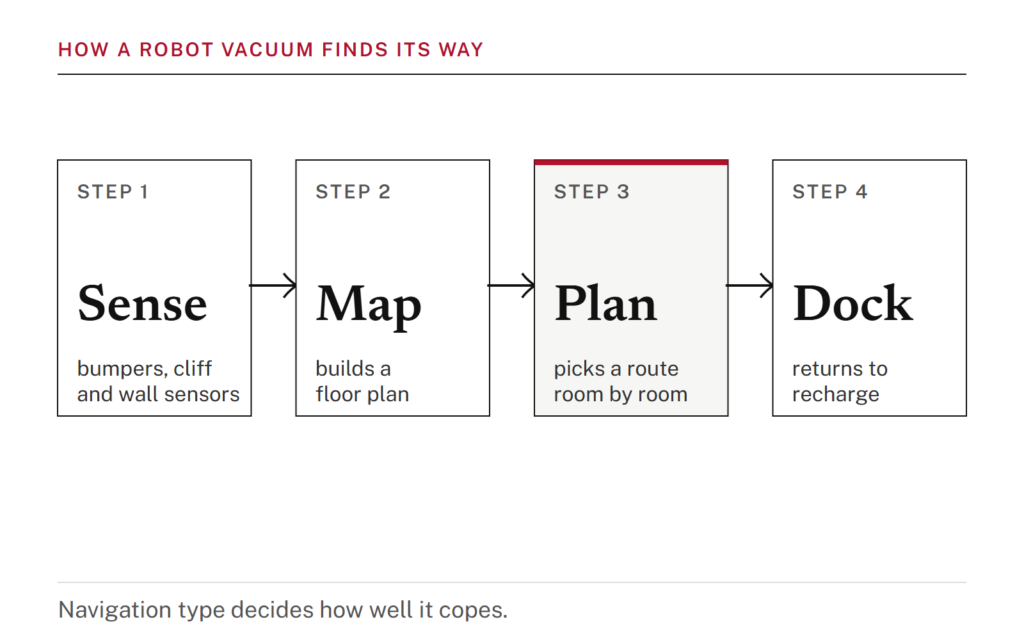
- A robot vacuum reads its surroundings with sensors, builds a map, plans a route and returns to its dock to recharge.
- How well it does that depends mostly on its navigation: random bumping, camera-based scanning or a laser.
- It still gets stuck where its sensors cannot see: mirrors, low light for camera systems, furniture that is too low, and stairs it cannot climb.
You press start and watch the first run: the machine rolls out from its dock, nudges a chair leg, turns without fuss and heads for the next room as if it knew the way. It does know the way, in a limited sense, and the reasons it sometimes gets lost say a lot about what you are buying.
Sensing: how it knows what is around it
TechRadar describes sensors as a robot vacuum’s eyes. Its usual set is infrared sensors for obstacles and edges, cliff sensors for drops such as staircases, dirt sensors for heavily soiled areas and, on certain budget models, bump sensors that fire on contact and make the machine turn. Roborock’s explainer, which describes how its S5 model works, adds detail: laser obstacle sensors measure the distance to what is ahead, a bumper with a pressure sensor confirms contact, and downward-facing cliff sensors spot big drops such as a staircase.
Some newer machines add a camera. Reviewed, a product-testing site, says that with machine learning a robot vacuum can work out what its camera is looking at, so it can steer clear of power cables yet roll straight through a bed skirt.
Navigation: three approaches
Navigation falls into three broad types, and the differences explain most of the price and behavior gaps between machines.
- Random bumping. The oldest approach follows a preset route and changes direction when it collides with something. Eufy, a robot vacuum maker, says it has no global view, tends to get stuck in complex rooms, and cannot produce a whole-home map or virtual walls. Reviewed adds that without a mapping technology a robot vacuum tends to wander and cover the same spot again and again, a major complaint about the first generation.
- Camera-based scanning. This reads landmarks through a camera, builds a map and plans a route, and it costs less than a laser system. Home Vacuum Zone, a review site, says it performs poorly in darkness and that rooms that are mostly empty or full of repeating patterns throw it off.
- Laser navigation. A spinning turret measures the distance to walls and furniture and builds a detailed map. TechRadar rates it as the fastest and most dependable form of navigation. The catch is that the raised turret makes the machine taller, so it cannot go under particularly low furniture, and mirrors can bounce the laser back and distort its sense of location.
Mapping and planning
Mapping is what turns sensors into a route. Roborock names the technique SLAM: the machine creates a map while working out where it is within that space. Its explainer says the machine starts with the edges of the room, then works through the middle in an s-shaped pattern, and because it tracks the route on its map it knows when every area has been covered. Some advanced models also let you view the map in an app and send the machine to specific rooms or areas.
Cleaning and going home
The cleaning itself is plain. A side brush sweeps along edges, a center roller, usually rubbery, lifts dust off the floor, and suction pulls air into the dustbin and through a filter. A basic machine cleans until its battery runs low and then heads back to its dock to recharge before the next run.
A short history of getting it right
Early machines struggled with exactly the problems above. According to Wikipedia, Electrolux introduced the first robotic vacuum cleaner in 1996. It collided with objects, stopped short of walls and left small areas uncleaned, and it failed in the market. In 2002 iRobot launched the Roomba, which could change direction at an obstacle, detect dirty spots and identify steep drops, and Wikipedia calls it the first commercially successful robot vacuum. In 2010 Neato Robotics introduced one of the first models to use laser-based mapping, which let a robot clean in systematic straight lines rather than at random.
Why they still get stuck
Any map is only as good as what the sensors can see. The S5 described earlier also carries a pressure-sensitive height sensor that warns it off furniture that sits too low to pass under. Home Vacuum Zone says dark or black carpets can confuse certain cliff sensors, so the robot may skip them, and that none of the consumer models on sale can climb stairs. According to Eufy, most robot vacuums cannot handle going downstairs on their own, although nearly all of them now have sensors that detect a sudden drop.
What this means when you shop
The navigation type is the spec worth reading first. A machine with random bumping may be fine in one open room, while a laser-mapped one makes more sense in a home with several rooms and furniture to weave around. Measure the gap under your sofa and bed before you buy, because a tall laser turret can keep a machine out. Nearly all current machines have anti-drop sensors, so stairs are a limit of climbing, not a danger of falling.