The short answer
- Owners report three to five years from a robot vacuum, while one maker says four to six, so plan on the lower figure.
- The battery is usually the first part to fade, at roughly 2 to 5 years, and brushes and filters wear before motors and sensors do.
- Heavy pet hair, thick rugs and neglected cleaning shorten the life, and regular upkeep is the cheapest way to extend it.
Your robot vacuum starts giving up before the job is done: shorter runs, a new rattle, a stall in the same corner of the living room. The useful question is whether this is the end or a battery away from being fine.
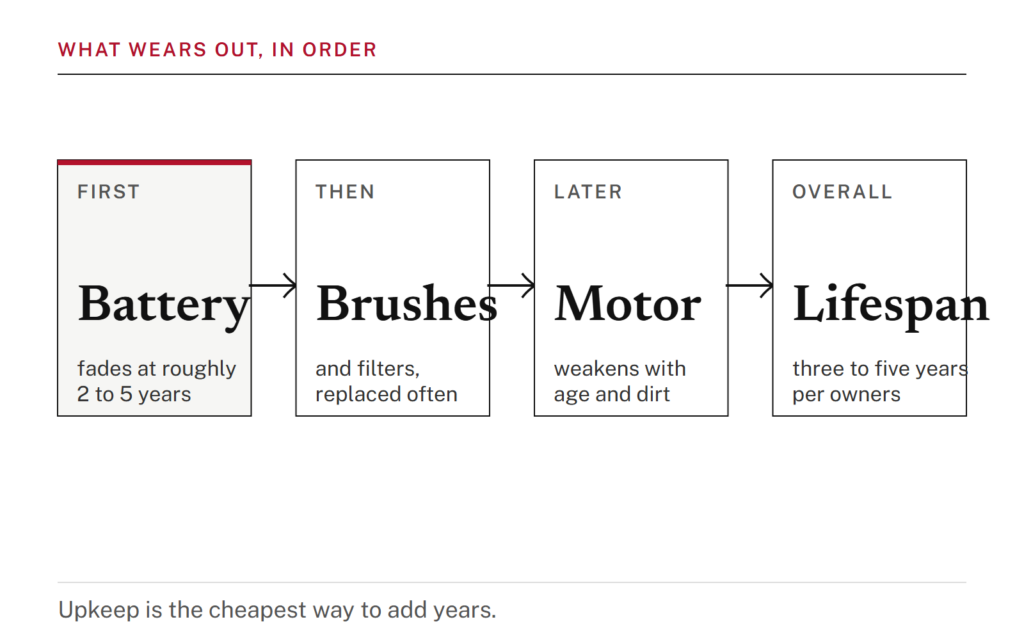
What the sources say about lifespan
Where sources disagree
BGR
Among owners, the consensus is that a robot vacuum lasts three to five years.
Ecovacs
Robot vacuums typically last four to six years, depending on how well they are built, how often they run and how well they are looked after.
Our read
The maker’s range sits about a year above the owners’ range, which is what you would expect when one side sells the machines and the other lives with them. We would plan around three to five years, and treat anything beyond that as a bonus rather than a promise.
The extremes
Averages hide the spread. BGR collected owner reports in which one robot failed before the 10-month mark and another barely reached 18 months. At the other end, an owner’s vacuum ran for over 10 years until its brush motor gave out, and a similar Roomba lasted just as long after four new batteries and a replacement bumper sensor. Another owner was still using a Roomba after nine years, having replaced the battery and the brushes and cleaned the brushes every month. Longevity, in other words, often means a machine that has had its wear parts replaced.
The battery goes first
Dreame puts the first big loss of capacity in lithium-ion cells at around 400 to 500 charge cycles, or roughly 2 to 5 years depending on use; when capacity falls to about 80%, runs get shorter and the robot may not finish its route. Battery life also depends on charging habits, clean charging contacts and timely replacement, according to one maker. A short runtime is therefore the likeliest first sign, and a replacement battery is often the cheapest repair.
What shortens a robot vacuum’s life
- Dirt and hair. Ecovacs lists heavily shedding dogs, outdoor shoes worn indoors and living near highways or construction as conditions that make a robot wear faster.
- Heavy use in a demanding home. Another maker points out that daily runs in a big home with pets wear a machine far more than occasional runs in a small, tidy one.
- Thick rugs and hard debris. Narwal points to deep carpet, heavy rugs and gritty debris such as sand or pet kibble, all of which make the motor work harder.
- Budget construction. Dreame says cheaper vacuums may use weaker motors and thinner materials that wear out faster, and one maker also claims premium models last longer. That is a claim from a company that sells premium models, so weigh it accordingly.
What extends it
The same owner roundup calls maintenance the key factor: clean the brushes and filters, which fill with hair, clear tangled hair from the wheels, wipe the sensors, and pick toys and large debris off the floor so the robot is not colliding with them. One maker suggests cleaning the machine every 1 to 2 weeks and the brushes weekly, and another recommends weekly brush and sensor cleaning and timely filter replacements. Replace worn brushes and mops when they wear out, and check before buying that parts are easy to get, since an affordable machine is only affordable if its parts are.
Repair or replace?
Narwal says age catches up: weaker motors, tired batteries, and repair bills that stop making sense. A rule of thumb follows: if the battery or a brush is the only problem and the part is available, fix it; if the motor or the main board has failed on an older machine, the repair is rarely worth it.
A short checklist
- Note the age and how often it runs; a horizon of three to five years is realistic.
- If runs have shortened, suspect the battery first.
- Clean brushes, filters, wheels and sensors, and replace worn brushes and mops.
- Check that the parts you need are still sold before spending money.
- If the motor or board has failed on an older machine, put the money toward a replacement.