

Power bank boxes lead with big mAh numbers, but those figures say less than they seem and can mislead you at the airport. This guide explains how capacity is measured, how to size a bank for your phone or laptop, and what the common airline rules mean for each size. It ends with a short list of banks that fit the most common needs.
Key insights
- UGREEN Nexode Pro 10,000mAh: 10,000mAh capacity
- UGREEN Nexode 20000mAh 130W: 20,000mAh (72Wh) capacity
- BLUETTI X20: 153.6Wh capacity
mAh, watt-hours and why the numbers do not add up
Milliamp-hours describe charge at the battery cell's own voltage, typically around 3.6V or 3.7V for lithium cells. Your phone and laptop charge at higher voltages, so the bank has to step the voltage up, and that conversion costs energy. A phone with a battery a quarter the size of the bank will not get four full charges from it.
Watt-hours fix the comparison. To convert, multiply the mAh figure by the cell voltage and divide by 1,000. UGREEN's Nexode 20000mAh 130W, for example, is rated at 72Wh. The Wh figure lets you compare banks honestly and is the number airlines use.
How much capacity you actually need
Size the bank to the device that runs out first and how long you are away from an outlet.
- Phone top-ups on a normal day: 5,000mAh to 10,000mAh is plenty, and it stays light enough to carry.
- A phone plus earbuds and a tablet over a weekend: 20,000mAh gives room to spare.
- A laptop on a long travel day: 20,000mAh to 25,000mAh with high output.
- A gaming laptop away from outlets for hours: a larger battery rated well above 100Wh, with the flying trade-off that brings.
Heavier banks tend to stay at home. A bank you actually carry beats a bigger one left in a drawer.
Output watts decide what a bank can charge
Capacity is how much energy the bank holds. Output is how fast it can hand that energy over, and it decides which devices the bank can really charge. Phones need modest output. Laptops need a USB-C Power Delivery port strong enough to match the laptop's own adapter.
A low-output bank connected to a laptop can only slow the drain. A bank with 100W or more can charge most USB-C laptops at a proper pace. Multi-port banks share their total output, so the laptop gets less when other devices are attached.
Where to start
| Role | Model | Price | Why | Buy |
|---|---|---|---|---|
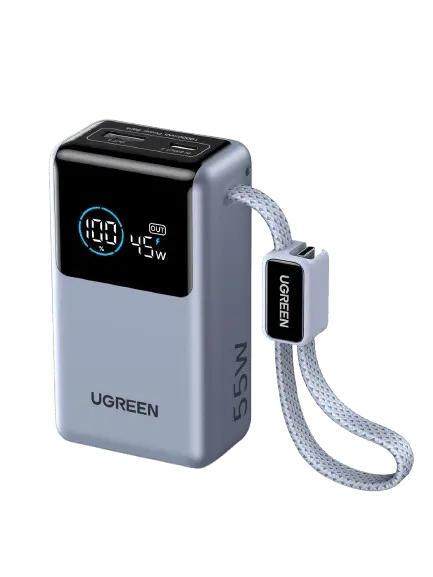
| Best on a budget | UGREEN Nexode Pro 10,000mAh | $45.99 | A pocket-size phone bank with 45W charging and its own cable, well under airline limits. | Check price |
| Best for most people | UGREEN Nexode 20000mAh 130W | $89.99 | Our top pick: 72Wh and 130W for a phone and a USB-C laptop on one trip. | Check price |
| Best for gaming laptops | BLUETTI X20 | $119 | 153.6Wh for gaming laptops, with 12 adapters; needs airline approval to fly. | Check price |
The airline rules most travelers run into
Aviation regulators treat power banks as spare lithium batteries, and the guidance most airlines follow is broadly similar. Power banks belong in carry-on bags, never in checked luggage. Banks up to 100Wh are generally allowed without approval.
Banks above 100Wh and up to 160Wh usually need the airline's approval, and carriers often cap how many of those you can bring. Anything larger is generally not accepted on passenger flights.
Individual airlines and countries add their own rules, and some now restrict using or charging a power bank during the flight. Read your carrier's page before each trip rather than relying on what was allowed last time.
Where to find the watt-hour rating
Most power banks print the Wh rating on the case, often in small type near the specifications. Security staff look for it, and a bank with no readable rating can be refused. If only mAh appears, the math above gives a close estimate: a 10,000mAh bank at 3.7V works out to 37Wh.
Some product listings skip the Wh figure entirely. In that case, check the label on the bank itself, or the manual, before your first flight.
Keeping a power bank healthy
Lithium batteries age fastest when they are hot or sitting at full or empty charge for long periods. Store a bank partly charged in a cool, dry place, and avoid leaving it in a car on a warm day. Top it up every few months if you are not using it.
Stop using any bank that swells, smells odd or gets unusually hot while charging. Those are signs of cell damage, and the bank should go to a battery recycling point rather than the trash.
FAQ
Why is my power bank's real capacity lower than the label?
The label gives the cells' stored charge at their own low voltage. Raising that voltage to charge a phone or laptop loses some energy, and more goes to heat in the cable and the device. That loss is normal and applies to every bank, wired or wireless.
Is a 20,000mAh power bank allowed on a plane?
Typically yes, in your carry-on. Banks of that size usually rate around 72Wh to 74Wh, below the 100Wh line most airlines use. UGREEN's 20,000mAh Nexode is rated at 72Wh. Check the label on your own bank to be sure.
Can I charge my power bank on the plane?
That depends on the airline. Some allow it, and some now ban charging or using power banks in the cabin. Check your carrier's current battery rules before you board, and keep the bank somewhere you can see it during the flight.
Does a higher-wattage bank drain faster?
Only if a device draws more from it. A bank with high output does not force power into a phone; the phone takes what it needs. A laptop will pull more and empty it faster, which is exactly what you bought the high output for.