The short answer
- Watt-hours are watts multiplied by hours, so a 100W load running for 5 hours uses 500Wh.
- A battery rated in amp-hours or milliamp-hours needs its voltage in the sum: Wh = Ah × V, or mAh × V ÷ 1,000.
- Plan for less runtime than the math gives, because inverter losses, cold weather and heavy loads all trim it.
The power goes out after dinner, and you want the router, a laptop and a couple of lamps to keep running until bedtime. Whether a given battery can manage that comes down to two pieces of arithmetic. Multiply watts by hours to find how much energy your devices will use, and multiply amp-hours by volts to find how much energy the battery holds. If the second number clears the first by a comfortable margin, you are fine.
Watts and watt-hours measure different things
Watts describe a rate, and watt-hours describe an amount. The U.S. Energy Information Administration draws the same line: watts capture power at one instant, while watt-hours total up the electricity used across a span of time. A tap running at a fixed rate is a fair picture: the flow is the watts, and the water that ends up in the bucket is the watt-hours. That is why 200W and 200Wh are not the same thing. The first is how hard a device pulls at a given moment, and the second is the energy it has used over time.
Storage works the same way. A battery holds energy, so its capacity is quoted in watt-hours or kilowatt-hours, never in watts. One kilowatt-hour is 1,000 watt-hours, and the same agency notes that electric utilities generally measure electricity in kilowatt-hours.
The two formulas that cover most cases
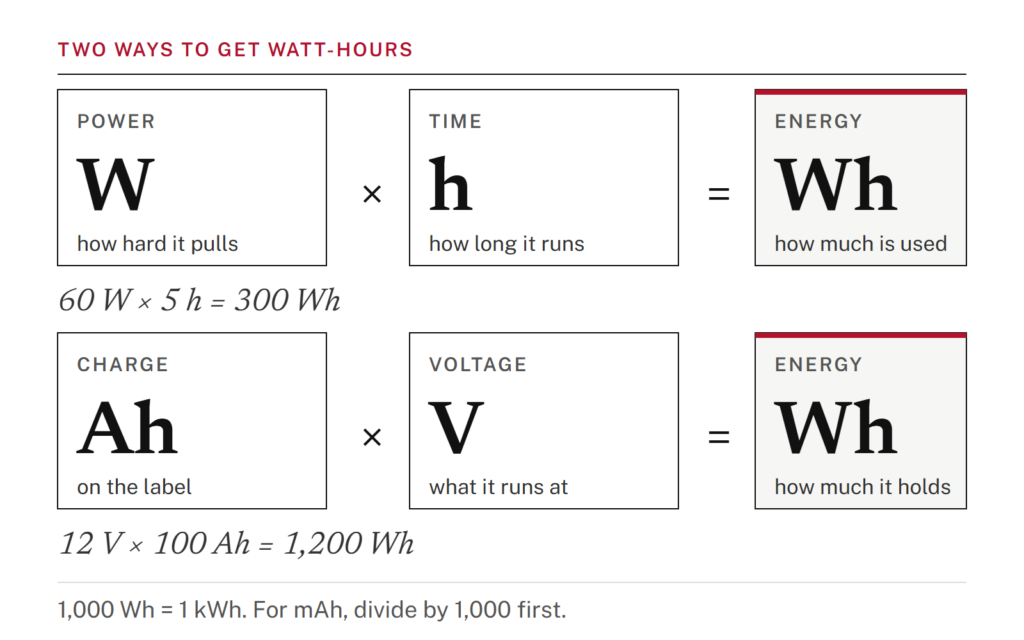
The first formula is Wh = W × h. Take a 60W device that runs for 5 hours: 60 × 5 = 300Wh. To express that in kilowatt-hours, divide by 1,000, which gives 0.3kWh. Virginia Cooperative Extension uses the same step for household appliances: wattage times hours of use, divided by 1,000, gives kilowatt-hours.
Rearranged, the same relationship gives you the other two values. Watts equal watt-hours divided by hours, and hours equal watt-hours divided by watts.
The only input that takes any care is the wattage. Virginia Cooperative Extension says most appliances have it stamped on the bottom or back, or on a nameplate, and for anything that cycles on and off, such as a refrigerator, use its average draw over an hour instead.
Converting amp-hours and milliamp-hours
Many batteries are labeled in amp-hours (Ah) or milliamp-hours (mAh). Those units describe charge, not energy, so the label alone cannot tell you how much a battery stores. Add the voltage and you get watt-hours, as Omni Calculator also explains: Wh = Ah × V. For a milliamp-hour rating, multiply by the voltage and divide by 1,000.
A 5,000mAh cell at 3.7V holds 5,000 × 3.7 ÷ 1,000 = 18.5Wh. A 12V battery rated at 100Ah holds 12 × 100 = 1,200Wh, or 1.2kWh. Going the other way, divide watt-hours by volts: 1,200Wh at 12V is back to 100Ah.
This is also why amp-hours are a poor way to compare batteries. Omni Calculator makes the same point: different battery types run at different voltages, so the bigger amp-hour number does not always mean more energy. Convert each one to watt-hours and they sit on the same scale.
From watt-hours to runtime
Runtime on paper is capacity divided by load. A 1,000Wh battery feeding a steady 100W load should last 1,000 ÷ 100 = 10 hours. That is the ceiling, not the forecast.
Most appliances run on alternating current, while a battery stores direct current, and the conversion costs some energy. EcoFlow, which makes home batteries, says modern inverters generally run at 85% to 95% efficiency. Put 90% into the example and the estimate becomes 1,000 × 0.9 ÷ 100 = 9 hours.
Why real runtime lands below the math
- Heavy draw. Pulling a very high wattage from a small battery can reduce the capacity you actually get, because of internal resistance and voltage sag.
- Temperature. Extreme cold slows the chemistry and shrinks the usable reservoir, and extreme heat raises internal resistance and wear. Battery University adds that a battery that delivers full capacity at 80°F will typically deliver only 50% at 0°F. A battery kept somewhere unheated can behave differently in January than in July.
- Depth of discharge. Batteries come with a recommended depth of discharge, which is a reason to look for a usable-capacity figure, where one is listed, instead of relying on the headline number alone.
- Startup surge. Heavy appliances such as well pumps and HVAC units need a burst of power to start. That burst is a question of power, not energy, so a watt-hour figure does not capture it.
Sizing a battery for an evening outage
Back to the evening outage. Say the router draws 12W and each of two LED lamps 10W, and all three stay on for 5 hours. The laptop charger draws 60W and runs for 3 of those hours.
- Multiply each wattage by its hours: the router uses 12 × 5 = 60Wh, the two lamps, 20W together, use 20 × 5 = 100Wh, and the laptop charger 60 × 3 = 180Wh.
- Add them up: 60 + 100 + 180 = 340Wh.
- Allow for the inverter. Dividing by 0.85, the cautious end of that 85% to 95% range, turns 340Wh into about 400Wh drawn from the battery.
- Compare that with the battery’s capacity in watt-hours, not amp-hours. A 500Wh battery clears 400Wh with some room to spare, and a 300Wh one does not.
- If the battery will sit somewhere cold, or has a recommended depth of discharge, leave extra room instead of planning to the last watt-hour.