

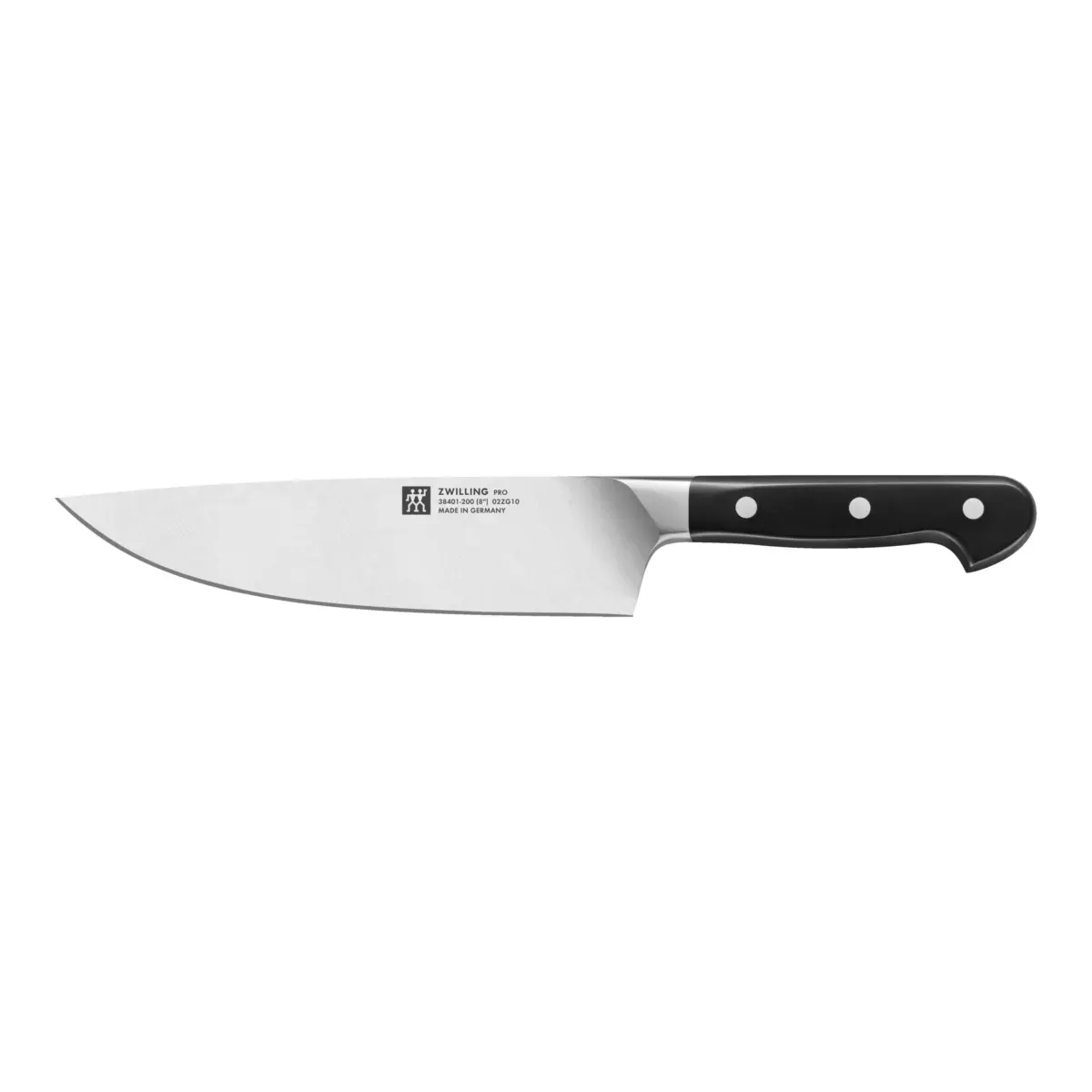
German and Japanese chef's knives do the same job, but they rest on different ideas about what a good edge should be. German knives favor tough steel, heft and a curved belly for rocking cuts, while Japanese knives favor hard steel, thin blades and fine angles for clean slices. Knowing which trade-off suits you matters more than any single brand.
Key insights
- ZWILLING Pro 8-inch Chef's Knife: Forged from a single piece (SIGMAFORGE) with a full tang
- MIYABI Evolution 8-inch Chef's Knife: FC61 fine carbide steel, ice-hardened to Rockwell 61
- MIYABI Artisan 8-inch Chef's Knife: SG2 (MC63) micro-carbide powder steel core, 63 Rockwell
Steel hardness and what it means
Knife steel hardness is measured on the Rockwell C scale. Japanese makers tend to run their steel hard: MIYABI rates its Evolution blade at Rockwell 61 and its Artisan blade, made from SG2 micro-carbide powder steel, at 63. Harder steel can be ground to a finer edge and keeps that edge longer.
The cost is brittleness. A very hard edge is more likely to chip than to bend, especially if it meets a bone or gets twisted in a dense vegetable. German steel is usually softer and tougher. It dulls a little sooner, but its edge tends to roll rather than chip, and a honing steel straightens it in seconds.
Blade shape and cutting style
A German chef's knife usually has a pronounced curve along the edge, so you can rock the blade with the tip anchored on the board. That motion is quick for mincing herbs and garlic. ZWILLING Pro adds a straighter section near the heel for chopping, which is one reason it adapts to so many cooks.
Japanese chef's knives, often called gyuto, have a flatter edge and a thinner spine. They are built for push and pull cuts, where the whole edge glides forward or back through the food. A thin blade wedges less, which is why it leaves cleaner slices of tomato and fish.
Weight, balance and construction
Forged German knives carry a bolster and a full tang, which puts weight behind the edge and makes them feel planted. That suits cooks who let the knife do the work through squash, cabbage or a whole chicken. Stamped German knives, such as ZWILLING Gourmet, are lighter and quicker in the hand while keeping the German edge shape.
Japanese knives are generally lighter for their length because the blade is thinner. Some, like MIYABI Artisan, pair a hard steel core with a decorative outer finish, in its case a hand-hammered Tsuchime surface that also helps food fall away from the blade.
Where to start
| Role | Model | Price | Why | Buy |
|---|---|---|---|---|
| Best for most home cooks | ZWILLING Pro 8-inch Chef's Knife | $169.99 | A forged German blade with a curved bolster for the pinch grip, made in Germany with a lifetime warranty. | Check price |
| Best Japanese-style blade | MIYABI Evolution 8-inch Chef's Knife | $139.99 | Seki-made FC61 steel at Rockwell 61, with a triple-riveted handle that German-knife owners will find familiar. | Check price |
| Best premium pick | MIYABI Artisan 8-inch Chef's Knife | $199.99 | An SG2 steel core at 63 Rockwell, a hand-hammered Tsuchime finish and a Cocobolo Rosewood Pakkawood handle. | Check price |
Western and Japanese handles
Most German knives use a Western handle: a full tang between two handle scales, held with three rivets. Japanese makers offer both Western and traditional styles. MIYABI Evolution keeps a triple-riveted handle so it feels familiar to German-knife owners, while MIYABI Artisan has a D-shaped Pakkawood handle designed to nestle into the hand.
Handle choice is mostly about comfort. If you already own a German knife and like how it feels, a Japanese knife with a Western handle is the easiest switch.
Sharpening and everyday care
German knives are the low-maintenance choice. Regular strokes on a honing steel keep the edge aligned, and an occasional session on a whetstone or a decent sharpener restores it. ZWILLING lists its Pro and Gourmet knives as dishwasher safe, though it recommends washing them by hand.
Japanese knives ask more of you. Their hard, thin edges are best kept on whetstones at the angle the maker set, which for MIYABI Artisan is 9.5-12°. Wash them by hand, dry them straight away, and use a wooden or plastic board, since glass and stone boards are hard on fine edges.
Which style should you buy
Buy a German knife if you want one blade for everything, cut with a rocking motion, or share the kitchen with people who are not gentle with knives. Buy a Japanese knife if you prep a lot of vegetables or fish, prefer push cuts and are willing to learn whetstone sharpening.
Many cooks end up with both: a sturdy German knife for heavy jobs and a thin Japanese blade for fine work. Our chef's knife shortlist has picks from each tradition, and the ZWILLING Pro vs MIYABI Evolution comparison puts the two styles head to head.
FAQ
Are Japanese knives sharper than German knives?
Out of the box, Japanese knives usually combine harder steel with a finer edge angle, so they feel sharper and stay that way longer. A well-kept German knife is still plenty sharp for home cooking. The real difference is how the edge ages: Japanese edges last longer but can chip, while German edges dull sooner and are easier to restore.
Can I sharpen a Japanese knife with a German knife sharpener?
It is not ideal. Many pull-through sharpeners are set for the wider angle of a German blade, which would grind a Japanese edge to the wrong shape and remove more steel than needed. A whetstone, or a sharpener made for Japanese angles, keeps the edge the way the maker intended.
Which style is better for beginners?
A German knife is usually the safer start. Its tough steel tolerates twisting, bones and the occasional hard board, and a honing steel is easy to learn. Beginners who mostly cut vegetables and are happy to hand wash can still start with a Japanese knife that has a Western handle, such as MIYABI Evolution.
Do I need both a German and a Japanese knife?
No. One good 8-inch chef's knife covers almost everything a home kitchen asks of it. A second knife in the other style is a nice addition if you find yourself wanting either more heft for tough jobs or a finer edge for delicate slicing.