

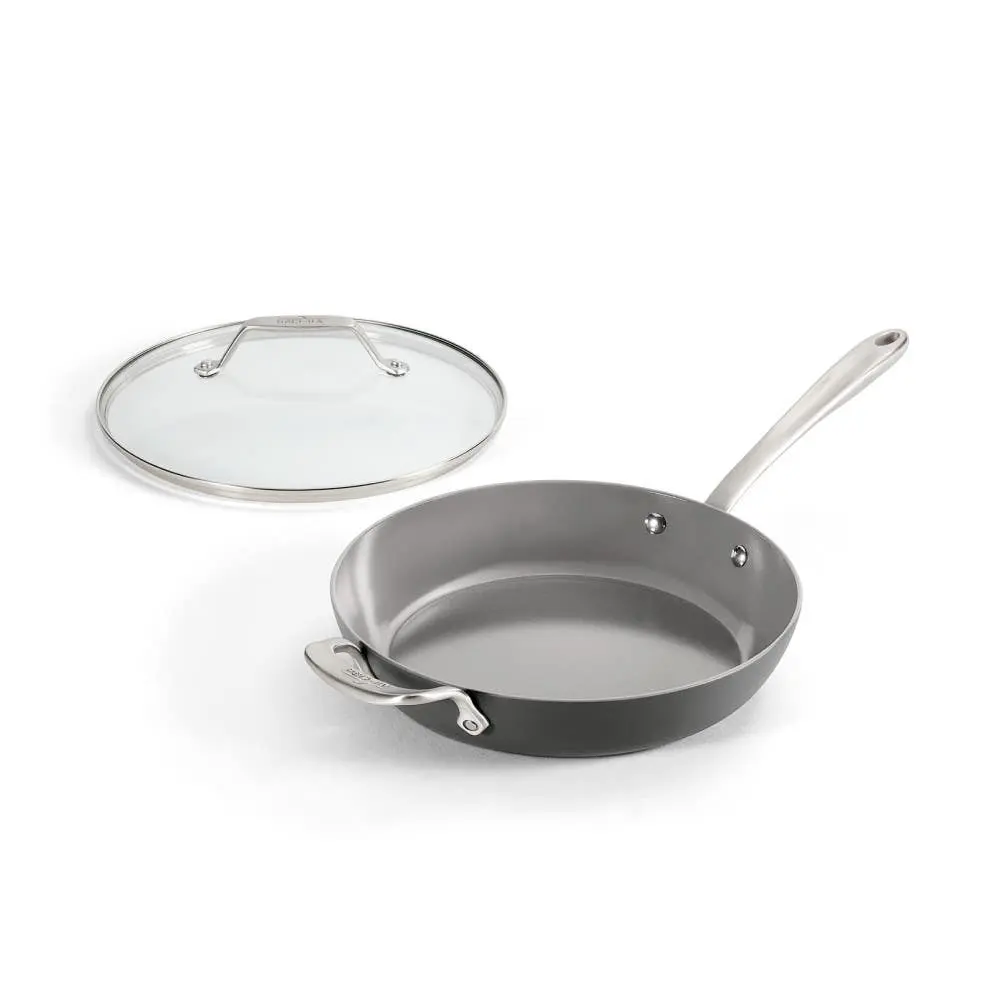
Ceramic and traditional nonstick pans look alike on the shelf, but the coatings behave differently on the stove and age differently in the cupboard. Traditional nonstick uses PTFE, a slick fluoropolymer, while ceramic pans use a hard, glassy coating made without it. This guide explains the practical differences so you can choose the right type before you compare brands.
Key insights
- All-Clad HA1 Ceramic 10.5-inch Fry Pan with Lid: Hard-anodized recycled aluminum body with a ceramic interior
- ZWILLING Peak 9.5-inch Ceramic Hybrid Frying Pan: Tri-ply 18/10 stainless-steel body
What separates the two coatings
Traditional nonstick, often sold under names like Teflon, is a PTFE coating bonded to a metal pan. PTFE is naturally slippery, so food barely grips it even with no fat in the pan. All-Clad's NS Pro and HA1 Expert lines are examples, and NS Pro bonds its PTFE with a layer of ceramic plasma for added scratch resistance.
Ceramic nonstick is a mineral-based coating applied as a thin layer and cured with heat. It starts out extremely smooth and releases food well, but its slickness comes from the surface finish rather than from the chemistry of the material. Pans like the Henckels Release, ZWILLING Milano and All-Clad HA1 Ceramic use this approach and are described as made without PTFE.
How each coating copes with heat
PTFE should not be overheated. Leaving an empty PTFE pan on a high burner can break down the coating and release fumes, so manufacturers advise low to medium heat. In practice that suits most of what people use nonstick for anyway: eggs, pancakes and fish.
Ceramic tolerates high temperatures without that fume concern, but high heat still shortens its useful life by wearing away release faster. Oven ratings for the pans we cover range from 400°F on Henckels Release and ZWILLING Milano to 500°F on ZWILLING Peak, while All-Clad's PTFE NS Pro pan is rated to 500°F. Neither type is the right pan for searing steak on full power every night.
How long the release lasts
This is the biggest practical difference. A good PTFE coating generally stays slick for longer, while ceramic tends to lose its easy release sooner, sometimes gradually and sometimes after one scorched meal or a run of cooking sprays. Brands are working on this: ZWILLING says its Ceraforce Titanium ceramic is up to 5x more durable than its previous version.
Warranties hint at what manufacturers expect. All-Clad backs its PTFE lines, such as NS Pro and HA1 Expert, with a limited lifetime warranty, while its ceramic HA1 and NS Pro Ceramic pans carry a 1-year limited warranty. Henckels and ZWILLING offer lifetime cover on their clad ceramic and hybrid pans, so the pattern is not universal, but it is worth reading before you buy.
Where to start
| Role | Model | Price | Why | Buy |
|---|---|---|---|---|
| Best for most kitchens | All-Clad HA1 Ceramic 10.5-inch Fry Pan with Lid | $99.99 | Our top ceramic choice, with a hard-anodized body, a glass lid and a 450°F oven rating. | Check price |
| All-Clad NS Pro Nonstick 10-inch Fry Pan with Lid | $79.99 | A PTFE pan reinforced with ceramic plasma, dishwasher safe and rated to 500°F. | Check price | |
| Best hybrid surface | ZWILLING Peak 9.5-inch Ceramic Hybrid Frying Pan | $79.99 | A tri-ply stainless hybrid that sears like steel and accepts metal utensils. | Check price |
Safety and the PFAS question
Many buyers choose ceramic to avoid PFAS, the family of fluorinated chemicals that includes PTFE under broad definitions. The ceramic pans on our shortlist are described as made without PFAS, PFOA, PTFE, lead and cadmium. If keeping fluoropolymers out of your kitchen matters to you, ceramic is the straightforward answer.
PTFE cookware used at sensible temperatures is widely regarded as safe for cooking, and the main risk is overheating an empty pan. The decision is less about acute danger and more about personal preference and how much you trust yourself to keep the heat moderate.
Cleaning, utensils and everyday care
Both coatings prefer wood, silicone or nylon tools and a soft sponge. Dishwasher ratings vary by model rather than by coating type: Henckels Release, ZWILLING Milano and All-Clad NS Pro are listed as dishwasher safe, while All-Clad's HA1 Ceramic and NS Pro Ceramic are hand wash only.
Ceramic is more sensitive to aerosol cooking sprays, whose residue bakes onto the surface and causes sticking. A small amount of butter or oil works better. The exception to the soft-tools rule is hybrid cookware like ZWILLING Peak, where a raised stainless pattern protects the ceramic and the maker rates it safe for metal utensils.
Which type should you buy
Choose traditional PTFE nonstick if you want the longest-lasting, most effortless release for eggs, crepes and fish, and you are happy to keep the heat moderate. Choose ceramic if you want a pan made without PTFE and PFAS, accept that the pan might need replacing sooner, and will treat the surface gently.
Choose a hybrid if you sear often and want a coated pan that tolerates metal tools and higher heat. Many kitchens end up with two pans: a nonstick or ceramic pan for eggs and a stainless or hybrid pan for browning. Our ceramic frying pan shortlist covers the best ceramic options in detail.
FAQ
Is ceramic nonstick better than Teflon?
Neither is better for everyone. Ceramic is made without PTFE and PFAS, which matters to many buyers, while traditional PTFE nonstick generally keeps its release longer. Pick based on which of those two qualities you value more.
Why does my ceramic pan start sticking?
The most common causes are high heat, cooking sprays and abrasive cleaning. Each one wears or coats the glassy surface. Cooking over medium heat with a little oil and washing gently will slow the loss of release.
Can ceramic and nonstick pans go in the oven?
Most can, but limits vary. The pans in our guide range from 400°F to 500°F, and glass lids often have a lower limit, such as 350°F on All-Clad lids. Check the rating for your specific model.
Do I need a separate pan for searing?
For regular high-heat searing, yes, unless you choose a hybrid. Stainless, cast iron and carbon steel handle full heat without coating wear, while coated pans are best kept for gentler cooking.