

These two 8-inch knives come from the same company but follow opposite traditions. ZWILLING Pro is a forged blade made in Germany, built for toughness and a rocking cut. MIYABI Evolution is handcrafted in Seki, Japan, with a thin, hard FC61 steel blade aimed at precise slicing, yet it keeps a Western-style triple-riveted handle.
Most home cooks should buy the ZWILLING Pro: it tolerates rough handling, works for both rocking and chopping, and comes with a lifetime warranty and clear care guidance. Buy the MIYABI Evolution if you cut a lot of vegetables and fish, like a push cut, and will hand wash and sharpen on a whetstone, because its harder, thinner edge gives cleaner, finer slices.
Key insights
- ZWILLING Pro 8-inch Chef's Knife: Forged from a single piece (SIGMAFORGE) with a full tang; Curved bolster designed for the pinch grip
- MIYABI Evolution 8-inch Chef's Knife: FC61 fine carbide steel, ice-hardened to Rockwell 61; Thin blade, hand-honed with the three-step Honbazuke process
Tough German steel vs hard Japanese steel
MIYABI gives the Evolution a number: FC61 fine carbide steel ice-hardened to Rockwell 61 through a six-step process it brands FRIODURx2. The brand likens the steel to the kind used in razor blades and promises sharpness, edge retention, corrosion resistance and chip-resistant toughness. ZWILLING describes the Pro's special-formula, high-carbon stainless steel and FRIODUR ice-hardening but lists no hardness figure.
As a rule, harder steel holds a finer edge for longer, while softer German steel bends before it breaks and is easier to bring back with a honing steel. If you want the knife to stay keen between stone sessions, the Evolution has the advantage. Winner: MIYABI Evolution, for edge retention.
Blade profile and cutting style
The Pro's edge curves strongly toward the tip, so you can rock it through herbs and garlic, and it straightens near the heel for chopping. It is a forged blade with real weight behind it, which helps when you split a squash or work through a heap of root vegetables.
The Evolution has what MIYABI calls an authentic thin Japanese profile, mirror polished with a sandblasted katana edge. A thin blade wedges less, so it parts onions, tomatoes and fish with less force and less tearing. It is less suited to hard, heavy jobs, where a thin edge can chip. Winner: ZWILLING Pro for versatility, though the Evolution is the finer slicer.
Handle and grip
Both knives use triple-riveted handles, which is why the Evolution feels less foreign to German-knife owners than most Japanese blades. Its handle is glass-fiber enhanced POM, curved for comfort and thicker at the end so your hand cannot slide back, and MIYABI lists nine hand-finishing steps plus a rounded spine, heel and bolster.
The Pro answers with its curved bolster, which leaves room for thumb and forefinger in a pinch grip. Both are designed for comfort over long prep, so this comes down to hand size and preference. Winner: tie, with a slight nod to the Pro for pinch-grip support.
Care, warranty and where they are made
ZWILLING makes the Pro in Germany, lists it as dishwasher safe with hand washing recommended, and backs it with a lifetime warranty. The Evolution is handcrafted in Seki, the town where samurai swords were once forged, and its listing gives neither a dishwasher rating nor a warranty term. Treat it as hand wash only, as with any hard Japanese blade.
Sharpening differs too. The Pro is happy with a honing steel and most home sharpeners, while the Evolution's Honbazuke edge is best maintained on a whetstone. Winner: ZWILLING Pro, for easier care and stated warranty cover. Our full ZWILLING Pro review goes deeper on its design, and the German vs Japanese guide explains the wider trade-off.
FAQ
Which knife stays sharp longer?
On paper, the MIYABI Evolution. Its FC61 steel is hardened to Rockwell 61, and harder steel generally holds an edge longer. ZWILLING does not publish a hardness figure for the Pro, but as a German blade it gives up some edge retention in exchange for toughness and easy honing.
Can I use the MIYABI Evolution on bones or frozen food?
It is better not to. A thin, hard edge like the Evolution's can chip if it is twisted against bone or forced through frozen food. Use a heavier German knife such as the ZWILLING Pro, or a cleaver, for those jobs, and keep the Evolution for produce, fish and boneless meat.
Are both knives sold at the same store?
Yes. ZWILLING and MIYABI both belong to the Zwilling group, and both knives are sold through Zwilling's US online store, which is where we checked their listings and prices. Shared ownership also explains the overlap in technology, since both blades carry a version of the FRIODUR ice-hardening treatment.
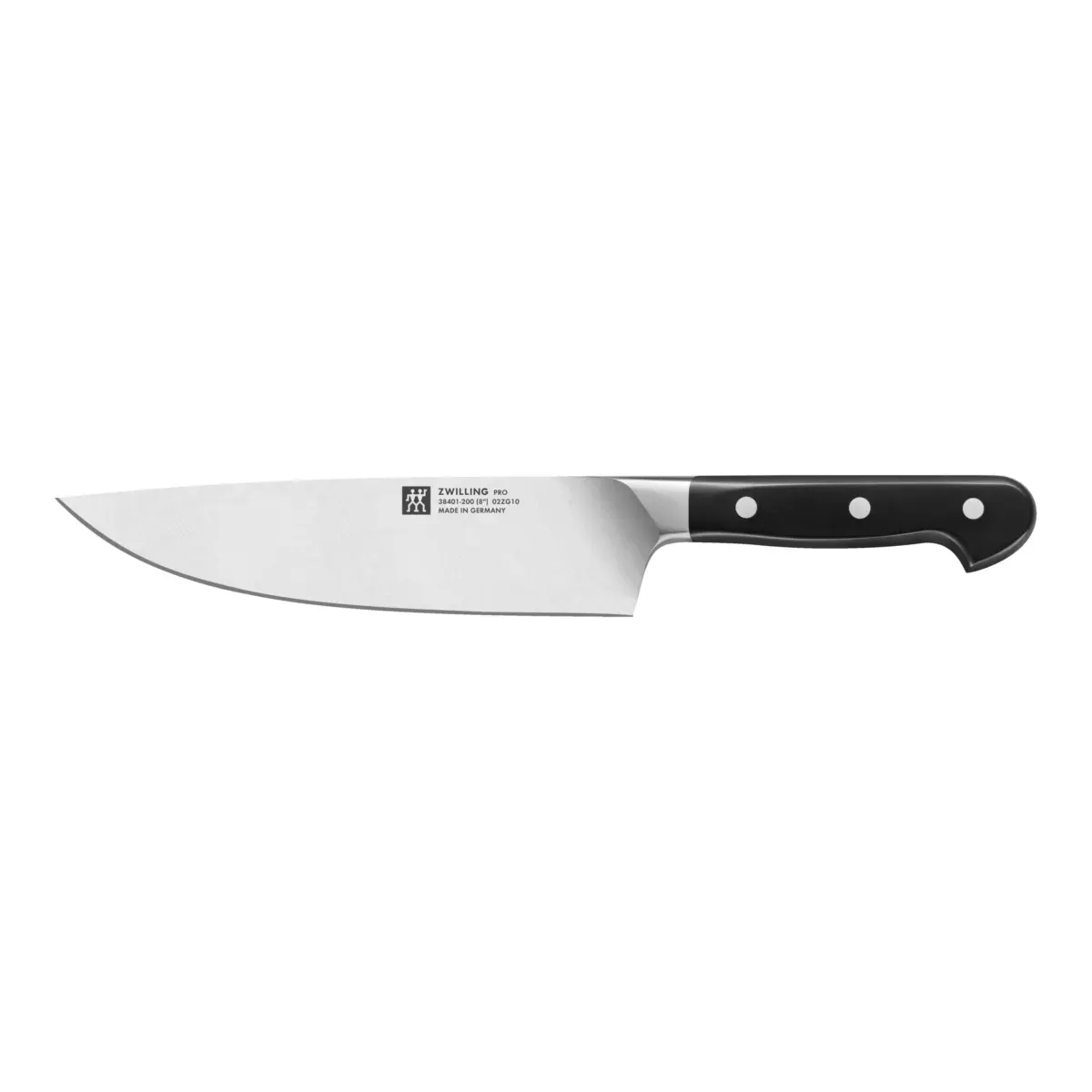 ZWILLING Pro 8-inch Chef's Knife
8.9 Very good Check price |
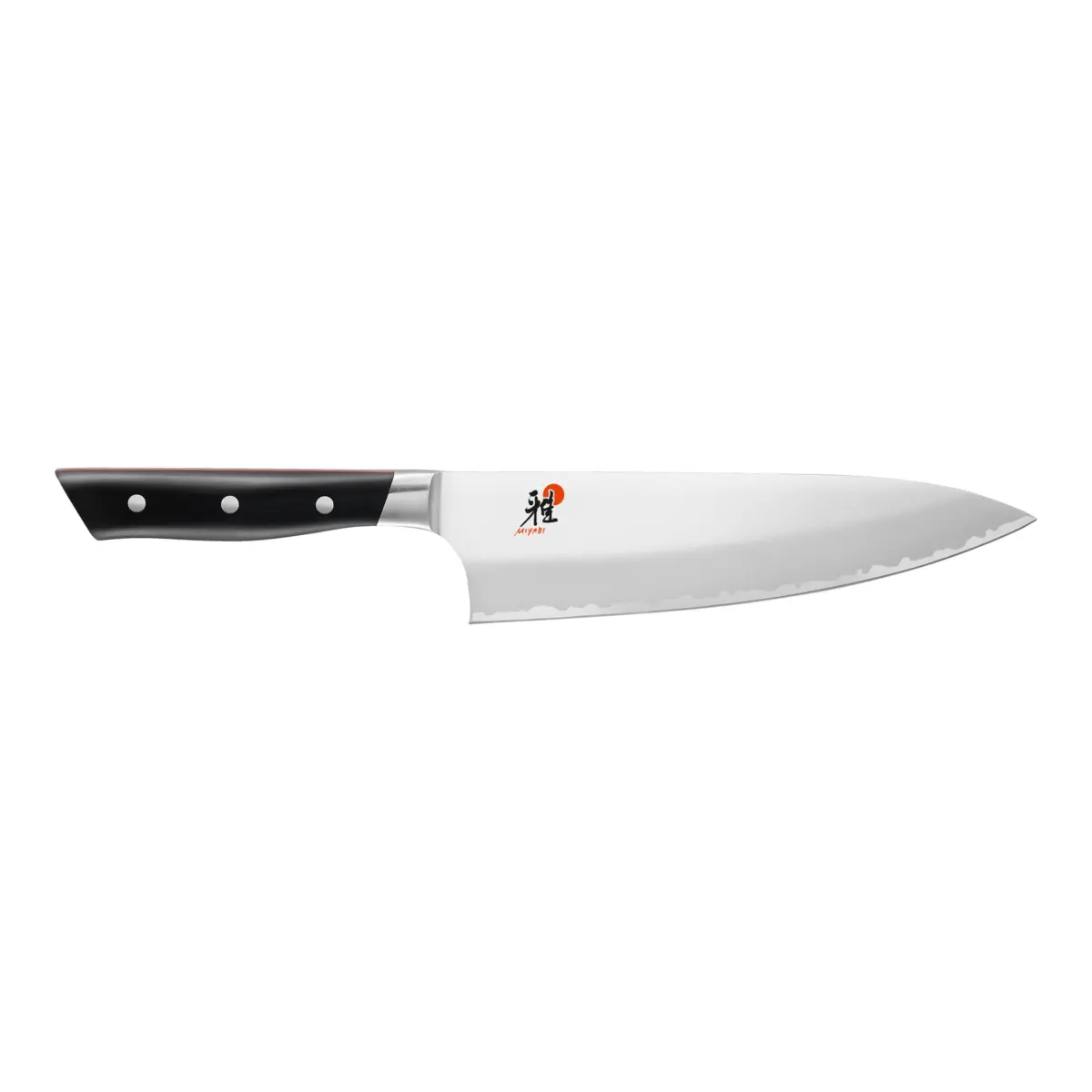 MIYABI Evolution 8-inch Chef's Knife
8.4 Very good Check price |
|
|---|---|---|
| Price | $169.99 | $139.99 |
| Best for | Best for most home cooks | Best Japanese-style blade |
| Blade length | 8 inch | 8 inch |
| Steel | Special-formula high-carbon stainless | FC61 fine carbide steel |
| Hardness | Not stated | Rockwell 61 |
| Hardening | FRIODUR ice-hardened | FRIODURx2, six-step ice hardening |
| Blade profile | Curved belly, straight back | Thin Japanese profile |
| Edge finishing | Precision-honed, laser-controlled | Hand-honed, three-step Honbazuke |
| Handle | Triple-riveted, curved bolster | Triple-riveted glass-fiber enhanced POM, red spacers |
| Care | Dishwasher safe, hand wash recommended | Not stated in listing |
| Made in | Germany | Seki, Japan |
Prices are the brands' own store prices; check the store before you buy.