The short answer
- The Jackery Explorer 1000 v2 and the Anker SOLIX C1000 Gen 2 are both roughly 1,000Wh LiFePO4 power stations that weigh about 25 pounds, so the choice comes down to power, charging speed, noise and price.
- Anker offers the higher output, more outlets and faster AC and solar charging, and it rates its battery at 4,000 cycles to 80%, a figure to compare with Jackery’s own rating; Jackery runs quieter, includes a built-in light and, in reviews, charged at a respectable pace without loud fans.
- Pick the Anker for power and speed; pick the Jackery for quiet and a built-in light, or whichever is cheaper on the day.
You are about to buy a power station for a weekend camper and the odd blackout, and two names keep coming up at roughly the same size and the same list price.
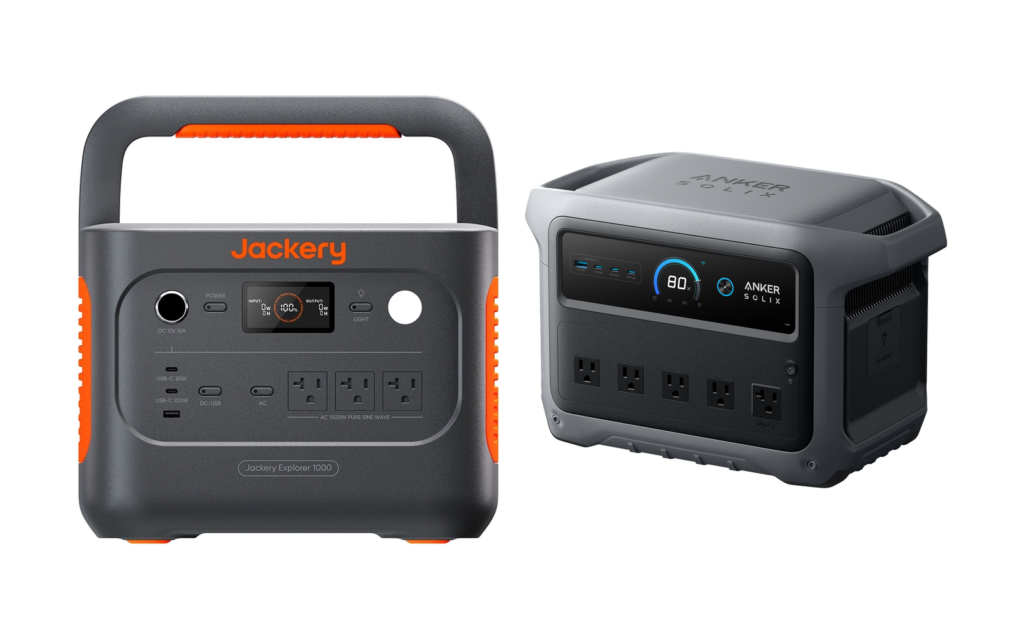
Two stations at the same size
Both machines sit at the small end of the one-kilowatt-hour class. The Jackery has a 1,070Wh battery, and the Anker a 1,024Wh one. The Anker is also sold in a nearly identical black version for big-box stores, called the C1000X. One review says the online version has an extra AC outlet, so it is the one to buy at the same price.
Spec check. Source: the makers’ pages and the reviews quoted below, checked August 2026
| Model | Claimed figure | What the number does not tell you |
|---|---|---|
| Capacity | Jackery: 1,070Wh. Anker: 1,024Wh. | Neither can be expanded. |
| Continuous output | Jackery: 1,500W. Anker: 2,000W. | The Anker also lists a 3,000W peak. |
| AC outlets | Jackery: three. Anker: five. | The Anker’s five are on the front. |
| AC charging | Jackery: 1,000W, 1,200W in emergency mode. Anker: 1,200W, 1,600W in ultra-fast mode. | Both fast modes are optional and work through an app or a setting. |
| Solar input | Jackery: 400W. Anker: 600W. | One review says Jackery’s website advertised 600W, which the unit’s own label does not support. |
| Weight | Jackery: 24.5 lb. Anker: 24.9 lb. | A difference of under half a pound. |
Power and ports
The Anker has the bigger inverter, which matters if you want to run a kettle, a space heater or a power tool. It is rated for 2,000W, against the Jackery’s 1,500W, and MacRumors ran it up to 1,500W without trouble. The Jackery handled just over its rating in a test, peaking at 1,560W for 10 minutes. So the Jackery can start and run most appliances, but the Anker has more room for a heavy load.
Ports differ too. The Anker has five AC outlets and the Jackery three, and the Anker offers two 140W USB-C ports on the front, which suit laptops. One reviewer noted that the outlets are tight if you want to plug in two bulky chargers. The Jackery has plastic covers over its outlets that keep moisture out, and its built-in light is a small but real advantage over the Anker, which has no practical working light.
Charging
Charging is where the Anker pulls ahead. In ultra-fast mode, one test took it from empty to full in about 47 minutes, and another measured 49 minutes, which is what Anker claims. The Jackery’s standard AC charge took about an hour and 35 minutes in a lab test, and The Drive reported getting from 30% to 100% in under 90 minutes.
There is a catch on the Anker. The fast mode only works when the battery is warm: Anker’s own FAQ says it activates above 20 °C (68 °F). On solar, the Anker finished in roughly 1.5 to 2 hours in one test, while the Jackery needed about 4.5 hours under optimal conditions.
Efficiency and real-world runtime
Both are efficient. At a heavy load of 1,479W the Jackery scored an efficiency of 87.5%, while the Anker’s efficiency was about 86% in another test. The Anker also idles at about 13.8W, so it can sit switched on for a few days.
On a work day, the Anker ran a MacBook Pro from 76 percent to 57 percent over eight hours, and nearly 24 hours with a full desk setup that includes a display and lights. A reviewer of the Jackery ran loads from 170W up to 1,500W without heat or fan trouble.
Smaller loads stretch much further. An at-home tester ran a television for 8 to 9 hours of nonstop use and craft tools such as foam cutters and wood burners for 50 hours or more. On the road, CleanTechnica used the Anker as a buffer for a vehicle’s fridge during a 4-day overlanding trip and reported that it performed flawlessly. Those are single experiences, but they show the range: a few hours for a television, days for small tools, and several days of travel when it could be topped up from a vehicle.
Noise
This is the clearest gap. A lab review found the Jackery fairly quiet even under heavy load, and called the low noise a pleasant surprise for a tent or bedroom. A reviewer of the Anker said that on a fast charge the fans kick on and sound like the unit is about to take flight, and that they would not sleep with the fans at that level. The same review adds that when charging small devices the Anker is near silent. So the noise is a charging cost, not a constant one.
Expansion and lifespan
The two reviews of the Anker disagree on whether it can grow.
Where sources disagree
The Solar Lab
An Anker expansion battery can add 1,056Wh for $399.
9to5Toys
Anker traded away expandability to make the Gen 2 smaller and lighter.
Our read
Anker’s own FAQ says the C1000 Gen 2 has no expansion feature and points people who need it to the older model. The maker is the better source here, so treat the Gen 2 as fixed capacity.
On lifespan, Anker says the battery keeps at least 80% after 4,000 cycles, and CleanTechnica calls 4,000 cycles excellent. Jackery publishes its own cycle rating, so compare it with Anker’s 4,000 before treating either battery as the longer-lived one.
Handling and design
Both weigh about the same, but they carry differently. The Jackery has a single fold-up handle that one reviewer found better for carrying one-handed, though that reviewer still preferred the two integrated handles on rival stations. The Anker has two side handles that also serve as tie-down points for a truck bed or a molle panel. At 25 pounds, MacRumors would not want to carry it to the beach or the park. The Anker’s screen was found easier to read than earlier Anker displays.
Backup duty and standby
For a home outage, small details matter. The Anker has a UPS function with a switchover under 10 milliseconds, so a plugged-in device can stay on when the power drops. It also held a full charge through a month powered off. Pass-through use differs. On the Jackery, the input power diminishes significantly under a heavy inverter load, while the Anker can pass power through from a gas generator at up to 1,800W. These are separate observations on different machines, not a head-to-head result.
Price and support
Both start at the same list price of $799: the Jackery on its own website, and the Anker as its MSRP. In practice neither sells at list. The Jackery was seen at $449 at one retailer, and the Anker’s usual range is $400 to $500. One reviewer found the Anker for $372, more than half off.
Support matters too. One review says Anker’s customer support may be the best of any power station brand, while the same site says Jackery’s has declined sharply over the past year. That is one reviewer’s experience, but it is worth weighing when the prices are so close.
Our read
The Anker is the better machine on paper: more power, more outlets and much faster charging, for the same weight and a similar street price, with a battery rated at 4,000 cycles that is worth setting against Jackery’s own rating. Its costs are fan noise when charging fast, no built-in light and a fixed battery. The Jackery is the quieter, simpler choice with a built-in light and a roomy handle, and it makes sense when you will charge slowly and care about silence.
Buy the Anker if output or recharge speed decides it. The one condition that flips the answer is sleeping next to the unit, where the Jackery’s quiet wins.
Who should buy what
A camper who needs quiet at night
The Jackery: a lab review found it fairly quiet even under heavy load.
A homeowner preparing for a blackout
The Anker: more outlets, higher output and much faster wall charging before a storm.
Someone who works from a laptop and a display
Either; the Anker’s 140W USB-C ports and 24-hour desk test make it slightly better.
A buyer who wants the lowest price
Whichever is on sale; both have sold for $450 or less.