The short answer
- A fridge’s label says 300 to 800 watts, but it cycles on and off, so that number says little about what it uses in a day.
- Published estimates of a day’s use run from about 1.3kWh to 4kWh, and a label-based upper bound reaches about 6kWh, so your own fridge’s label or a plug-in meter beats any average.
- A power station has to clear two hurdles: enough surge output to start the compressor, and enough watt-hours to last, counting its own idle drain.
On the hottest Saturday of the summer you stand in the kitchen, with a fridge packed for a family cookout and a utility warning of rolling blackouts, wondering whether a backup battery could keep it cold if the power drops for half a day.
The label wattage is not the daily number
EnergySage puts a typical home refrigerator at 300 to 800 watts but notes that actual use is much lower, because the compressor cycles on and off through the day, and it offers a rule of thumb: divide the stated wattage by 3. Aurora Solar draws the same line between stated and running watts, and says running wattage typically lands closer to 100 to 400 watts.
How much does it use in a day?
Where sources disagree
EnergySage
A typical refrigerator draws about 4kWh over a day.
The Solar Lab
Three household fridges tested in three homes each used roughly 1,300Wh per day.
Our read
The gap is a factor of about three. One figure works from an average rating, the other from measured fridges, and Aurora’s estimate multiplies the 300 to 800 watt label by an assumed 8 hours of running to get 2.4 to 6.4kWh a day. We would size a battery from a measured or label figure for your own fridge, with margin for the high end.
The start-up surge
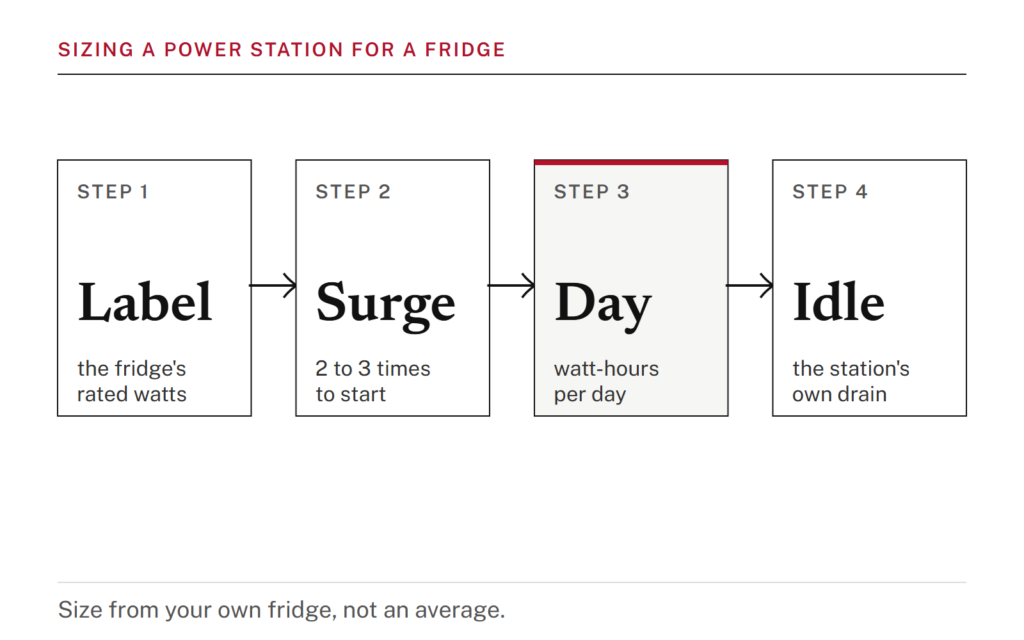
Whatever a fridge averages, it asks for more when the compressor starts. EcoFlow, a power station maker, says a fridge may need 2 to 3 times its normal power for a few seconds, so one running at 150 watts might need 300 to 450 watts to start. The station’s surge output has to cover that, and if it cannot, EcoFlow warns the fridge may fail to start or trip a safety shut-off. The station’s continuous output must also exceed the fridge’s running watts.
Watt-hours and idle drain
After surge comes capacity. As our watt-hours guide explains, runtime is capacity divided by load. The Solar Lab adds a cost that many reviews skip: a power station uses some energy just to stay on, for its display and inverter, so the capacity you need is the fridge’s consumption plus the idle rate multiplied by the hours.
In its example, a 12-hour outage costs a standard fridge around 650Wh, and a station idling at about 18 watts adds 216Wh, for 866Wh in all, which a 1,024Wh unit covers. The station maker’s more cautious view is that a full-size kitchen fridge may empty a 1,000Wh station in under 8 hours, which works out to at least about 125 watts on average. Over the same 12 hours that would be at least roughly 1,500Wh before idle drain. The spread between the two is the reason to measure your own fridge.
A short checklist
- Find your fridge’s EnergyGuide label, which lists estimated yearly kWh, and divide by 365.
- Note the running watts and expect a start-up surge of 2 to 3 times that.
- Compare both with the station’s continuous and surge outputs.
- Multiply by the hours you need, add the station’s idle drain, and keep some margin.
- Plan the recharge: wall charging can take from under an hour to several hours depending on the model, and solar is slower.