The short answer
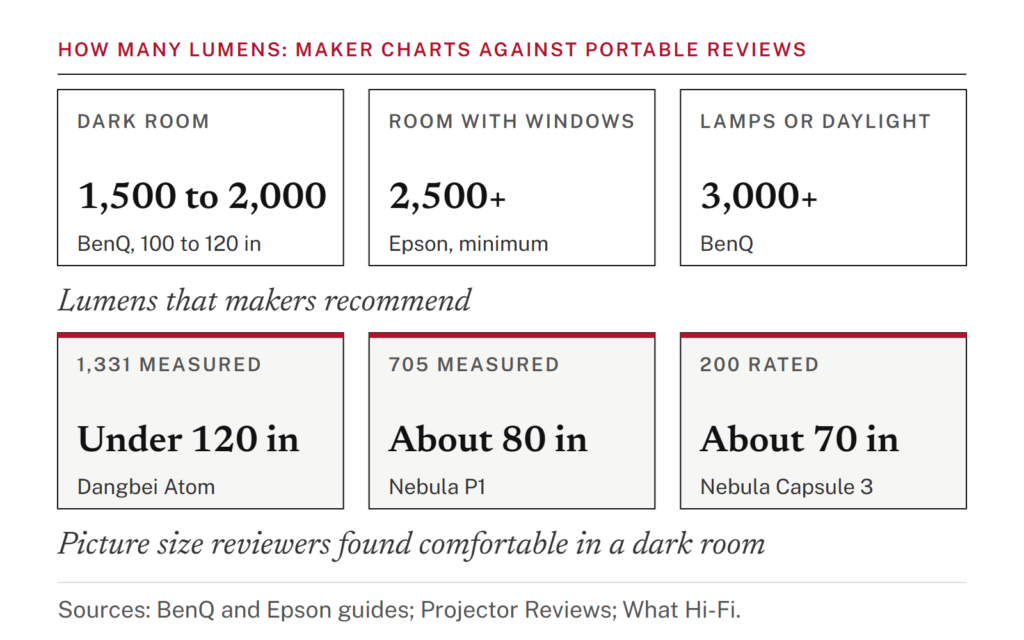
- In a dark room, reviewers found about 700 measured lumens comfortable at 80 inches and about 1,300 good up to 120 inches, well under the 1,500 to 2,000 that maker charts suggest.
- With lamps on or daylight coming in, maker guides start at 2,500 to 3,000 lumens, more than any portable projector on our list delivers.
- Trust ANSI or ISO lumens only; a figure in “LED lumens”, lux, or with no standard named cannot be compared with anything.
A spare room with one west-facing window and a white wall, and the plan is an afternoon game on a 100-inch picture, then a film after dark. Those are two different projectors’ worth of brightness, and the lumen figure on the box will not tell you which one you are buying. This guide sets out how many lumens each part of that day needs, and how to read the number before you trust it.
What the makers recommend
Projector makers publish rules of thumb, and they agree on the shape if not the numbers. BenQ puts a dark room with a 100 to 120 inch screen at 1,500 to 2,000 lumens, and that ambient light calls for 3,000 lumens or more. Epson puts the floor at 1,500 lumens for a home theater with little ambient light, and at 2,500 for rooms with windows. ViewSonic says a home projector under 3,000 ANSI lumens can manage an 80 inch image, provided you control the light in the room.
For the spare room, that puts the afternoon game at 2,500 lumens or more, because of the window. All three makers sell projectors, so treat their charts as a seller’s view, written with living rooms and classrooms in mind.
What reviewers found with portable projectors
Portable projectors sit far below those charts, and reviewers still get a watchable picture from them at night. The Dangbei Atom is rated at 1,200 ISO lumens, and Projector Reviews read 1,331 lumens off the screen at full output, while its everyday presets came in at 730 to 790. The same reviewer thought screens under 120 inches suit it best. A Nebula P1 measured 705 lumens, and its reviewer settled on 80 inches for good color and contrast, with 100 inches as the upper limit. The pocket-size Nebula Capsule 3 is rated at 200 ANSI lumens, and one review says the image starts to look dim once it goes much past 70 inches.
So for the evening film in the spare room, a projector measured at around 700 lumens covers 80 inches, and one measured at around 1,300 covers the full 100. Our guide to the best portable projectors compares those models in more detail.
Where sources disagree
BenQ
A dark home theater with a 100 to 120 inch screen needs 1,500 to 2,000 lumens.
Projector Reviews
One portable model looked best at 80 inches and topped out at 100, even in a dark room.
Our read
Both describe a dark room, but for different goals. The maker figure aims at a large, punchy cinema picture; the review shows what an evening in a dim room really needs. If you only watch after dark at 80 to 100 inches, you do not need to buy to the chart.
Why the number on the box is not enough
Lumens only compare fairly when they come from the same method. For years most legitimate makers used the ANSI method, which averages a 9-point measurement across the screen, and ProjectorCentral notes that ISO 21118 is slowly replacing it with a similar 9-point test on a full white frame. The same site says CVIA lumens, a Chinese industry figure, are not equivalent to either.
Some figures follow no standard at all. Epson has warned shoppers about lux, “LED lumens” and “lamp brightness” figures, and TechRadar found a $57 projector listed at 9,500 lumens. Epson has also taken other makers to court over brightness specs, and the settlements are telling. A Formovie portable projector went from an 800 lumen spec to 250 lumens, and a JmGo projector from 4,000 to 1,900. Brands such as Epson, Sony and JVC rate white brightness to ISO 21118, so that is the label to look for.
Spec check. Source: makers’ ratings and the reviews and settlements quoted on this page, checked August 2026
| Model | Claimed figure | What the number does not tell you |
|---|---|---|
| Nebula P1 | 650 ANSI lumens | Reached 705 in Conference mode, yet best kept to about 80 inches. |
| LG CineBeam Q | 500 lumens | The Brightest profile gave 262.9 lumens at default settings. |
| Dangbei Atom | 1,200 ISO lumens | Hit 1,331 at full output; everyday presets ran from 730 up to 790. |
| XGIMI Halo | 800 ANSI lumens at first | Revised to 600 ISO lumens; one sample measured 642. |
| Formovie P1 | 800 lumens at first | Lowered to 250 lumens in a settlement. |
A rating can also be reachable only in a mode nobody would watch. Tom’s Guide reached about 500 ANSI lumens from the CineBeam Q only with wildly bad image settings. On the Atom, the high-performance laser setting nearly doubled the output, at the cost of much louder fan noise. Epson adds that a single lumen rating usually means white brightness only, so colors can look dimmer than the number suggests.
Screen size changes everything
The same light spread over a bigger picture looks dimmer. A 100-inch picture is a quarter wider and a quarter taller than an 80-inch one, so its area is 1.25 × 1.25 = 1.5625 times larger. Each square foot then gets 1 ÷ 1.5625 = 0.64 of the light, roughly two thirds. That is why the reviews above set a comfortable size for each model, and why shrinking the picture by 20 inches does more than most settings menus.
Brightness can also be measured off the screen. On an 80-inch screen, TechRadar’s reviewer measured 109 nits from the Atom in Movie mode and 60 nits from the CineBeam Q in Filmmaker Mode. Light measured on the screen is the closest thing to what you will actually see.
Room light matters more than the spec
Light that falls on the screen washes out blacks first, then colors. One reviewer found that even moderate uncontrolled light, especially light shining onto the screen at an angle, quickly reduced image quality. Outdoors, Trusted Reviews says a 200-lumen model needs you to wait until it is fully dark. In the spare room, a blind on the west-facing window would do more for the afternoon game than any portable projector could. The Dangbei Atom, the brightest of the portable models we have looked at, still works best with the light kept low.
Who should buy what
Films after dark at 80 inches
A portable projector measured at around 700 lumens is enough; look for an ANSI or ISO rating.
Films after dark at 100 inches or more
Aim for around 1,300 measured lumens, or plan on a smaller picture.
A room you cannot darken
Look past portables to models rated 2,500 to 3,000 lumens or more, as the makers advise.
Backyard movies
Start after full dark and keep the picture modest; brightness drops fast as the screen grows.