

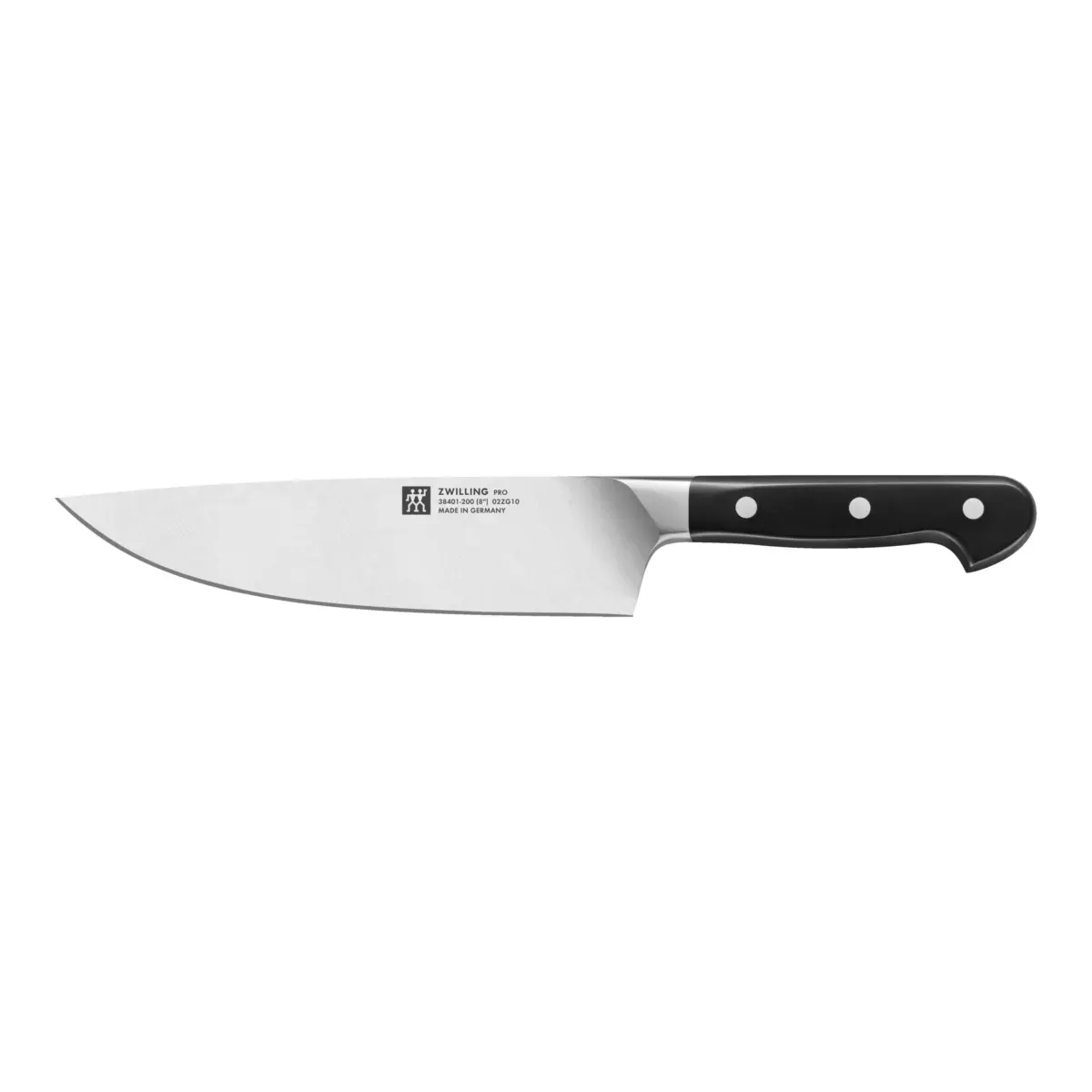
This shortlist is for home cooks replacing the knife they reach for most: the 8-inch chef's knife that handles onions, herbs, chicken and squash. All five come from brands in the Zwilling group, which lets us set a forged German workhorse, a lighter German option, a budget forged blade and two Japanese knives handcrafted in Seki against one another using the brands' own specs. If you only own one good knife, make it this size.
Key insights
- Best for most home cooks: The ZWILLING Pro 8-inch chef's knife combines a forged, full-tang German blade with a curved bolster built for the pinch grip and a lifetime warranty.
- Best on a budget: Henckels Pakka is our budget pick, and it still gives you a fully forged German stainless blade with a contoured Pakkawood handle.
- Who should skip an 8-inch knife: If you mostly cut bread, carve roasts or cook in a very cramped kitchen, a serrated bread knife, a slicer or a shorter chef's knife will serve you better.
Our top 5
- ZWILLING Pro 8-inch Chef's Knife — Best for most home cooks
- Henckels Pakka 8-inch Chef's Knife — Best on a budget
- MIYABI Evolution 8-inch Chef's Knife — Best Japanese-style blade
- ZWILLING Gourmet 8-inch Chef's Knife — Best lightweight German knife
- MIYABI Artisan 8-inch Chef's Knife — Best premium pick
1 ZWILLING Pro 8-inch Chef's Knife
Best for most home cooks. ZWILLING Pro is the knife we would put in most kitchens first. The blade is forged from one piece of ZWILLING's special-formula, high-carbon stainless steel and ice-hardened to the brand's FRIODUR standard, so it is tough enough for squash and chicken joints yet keeps a keen edge. Its standout detail is the curved bolster, shaped to support the pinch grip that gives a cook better control. A broad curve toward the tip suits rocking cuts, and the straighter back section handles up-and-down chopping. It is made in Germany with a lifetime warranty.
- Forged from a single piece (SIGMAFORGE) with a full tang
- Curved bolster designed for the pinch grip
- Ice-hardened FRIODUR blade; made in Germany, lifetime warranty
- ZWILLING calls it dishwasher safe but recommends hand washing, and the forged bolster adds heft that cooks used to light blades will notice.
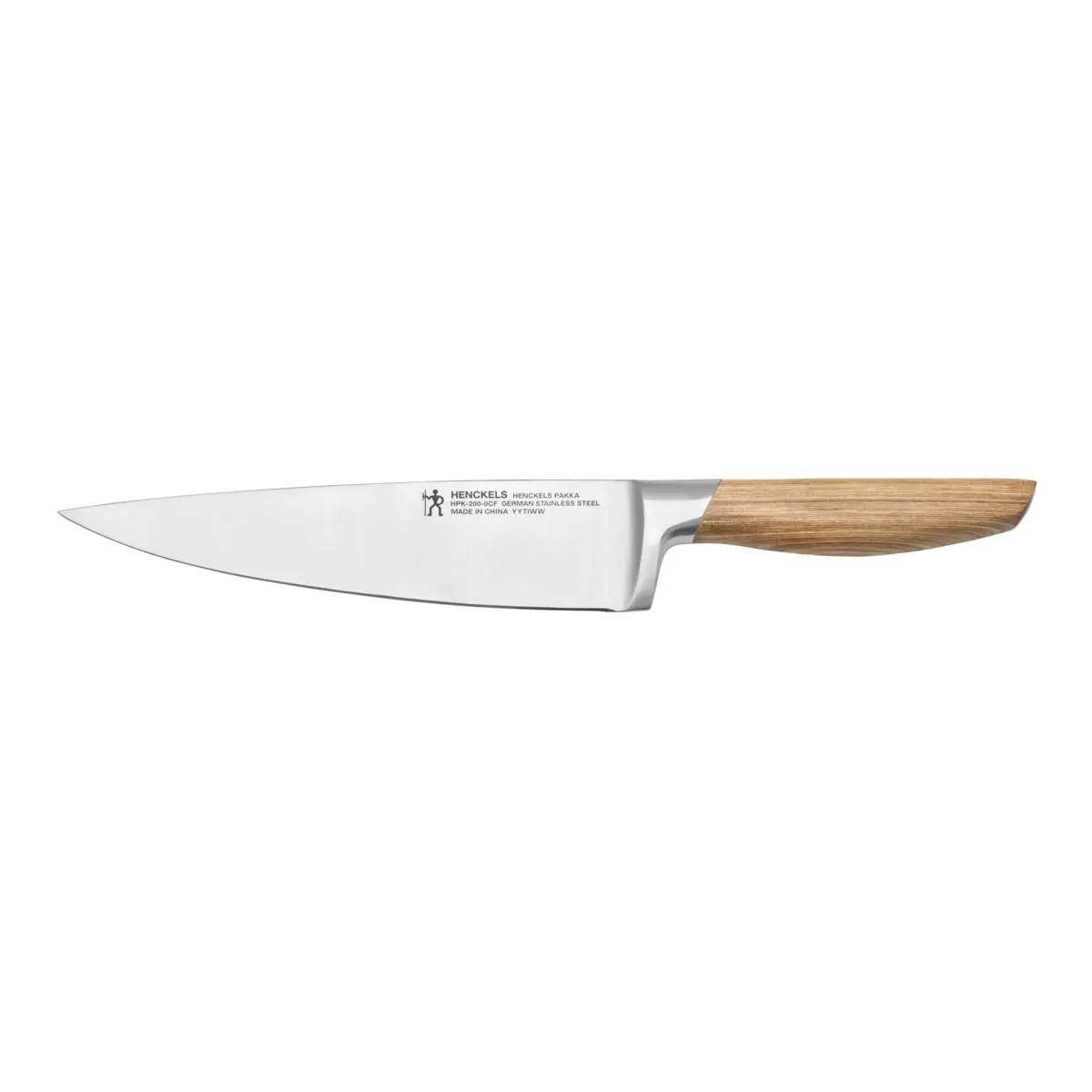
2 Henckels Pakka 8-inch Chef's Knife
Best on a budget. Henckels Pakka is the budget pick for anyone whose current knife is a dull leftover from an old block set. It is fully forged from a single piece of German stainless steel, which is uncommon among entry-level knives, many of which are stamped from sheet. The polished, light Pakkawood handle is contoured to fit the hand and gives the knife a warmer look than the black plastic found on most budget blades. Henckels describes the edge as finely honed for long-lasting sharpness, and the 8-inch blade covers herbs, onions and garlic without fuss.
- Fully forged from one piece of German stainless steel
- Polished, contoured Pakkawood handle
- Finely honed 8-inch blade
- It is hand wash only and the listing names no warranty term, so keep it out of the dishwasher and dry the wooden handle promptly.
 Henckels Pakka 8-inch Chef's Knife
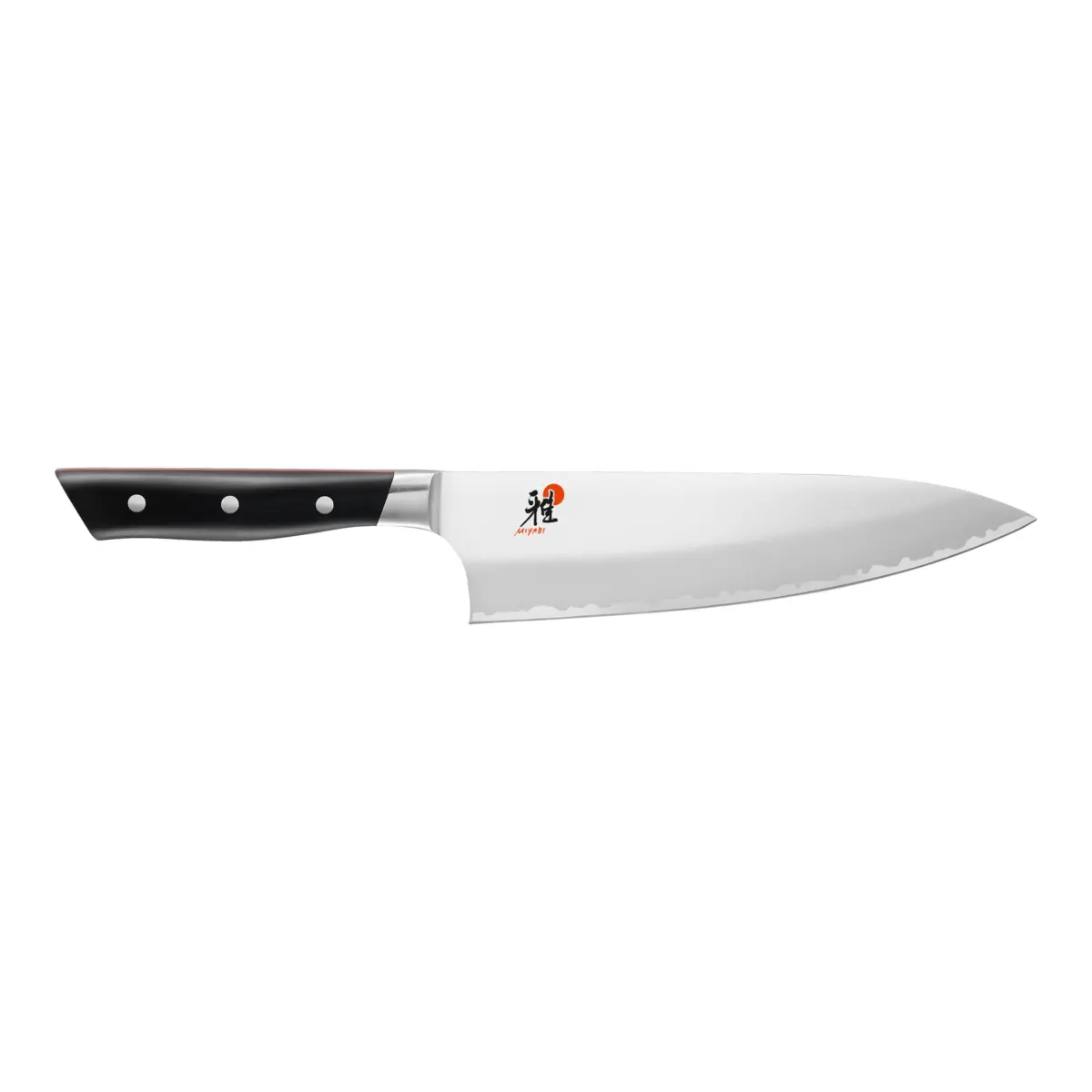
3 MIYABI Evolution 8-inch Chef's Knife
Best Japanese-style blade. MIYABI Evolution is the easiest step into Japanese knives for a cook raised on German ones. It is handcrafted in Seki from FC61 fine carbide steel and ice-hardened to Rockwell 61, so the edge starts very sharp and holds it for a long time. The blade follows a thin Japanese profile and is hand-honed with the three-step Honbazuke method. What keeps it familiar is the triple-riveted handle, curved for comfort and thicker at the end to stop your hand slipping. Pick it if most of your prep is fine slicing and dicing of vegetables and fish.
- FC61 fine carbide steel, ice-hardened to Rockwell 61
- Thin blade, hand-honed with the three-step Honbazuke process
- Triple-riveted glass-fiber enhanced POM handle with red spacers
- A thin, hard edge can chip on bones, frozen food or a glass board, so treat it as a knife for produce and boneless meat rather than heavy jobs.
 MIYABI Evolution 8-inch Chef's Knife
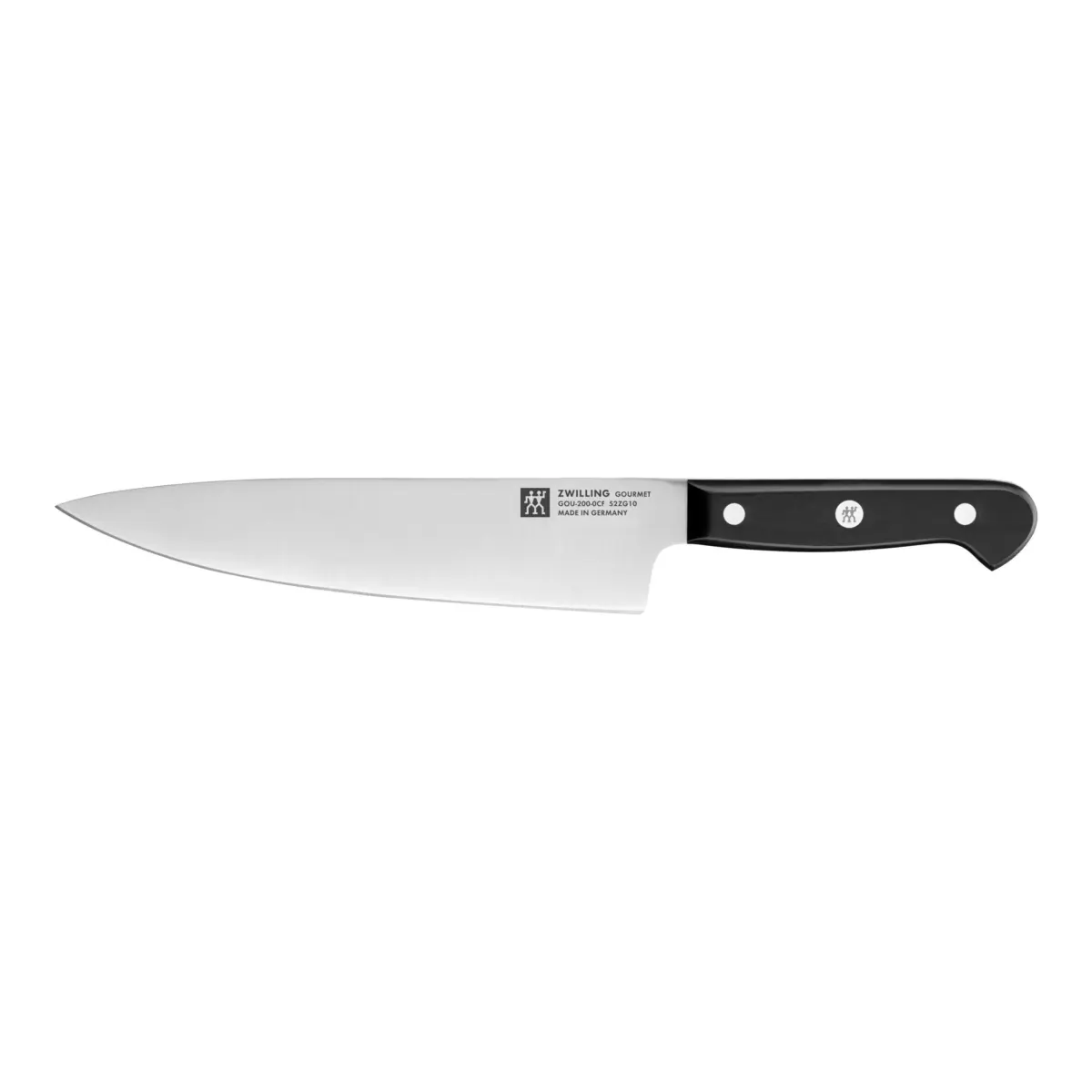
4 ZWILLING Gourmet 8-inch Chef's Knife
Best lightweight German knife. ZWILLING Gourmet is the German knife for cooks who find forged blades tiring to hold. Rather than forging it, ZWILLING precision-stamps it from a single piece of special-formula steel, which makes it lighter and quicker to maneuver. It still gets FRIODUR ice-hardening and a laser-controlled edge, plus a full tang and a traditional triple-rivet handle with the ZWILLING logo on the center rivet. That combination makes it a strong first serious knife, or a sensible choice for long prep sessions where wrist fatigue sets in. Like the Pro, it is made in Germany with a lifetime warranty.
- Precision-stamped from a single piece of special-formula steel
- Ice-hardened FRIODUR blade with a laser-controlled edge
- Full tang, triple-rivet handle; made in Germany
- With less steel behind the edge than a forged knife, it needs more effort from you on hard squash or a whole chicken.
 ZWILLING Gourmet 8-inch Chef's Knife
5 MIYABI Artisan 8-inch Chef's Knife
Best premium pick. MIYABI Artisan is the knife to buy when the look of the blade matters as much as its edge. The core is SG2 (MC63) micro-carbide powder steel rated at 63 Rockwell, the highest hardness figure on this list, wrapped in a hand-hammered Tsuchime finish that helps keep food from sticking. MIYABI hand-hones the blade with the Honbazuke method to a 9.5-12° edge angle, far finer than a typical German edge. The D-shaped Cocobolo Rosewood Pakkawood handle has brass and red spacers, a mosaic pin and a stainless-steel end cap. Each one is handcrafted in Seki.
- SG2 (MC63) micro-carbide powder steel core, 63 Rockwell
- Hand-hammered Tsuchime finish to reduce sticking
- 9.5-12° edge angle; D-shaped Cocobolo Rosewood Pakkawood handle
- It is hand wash only, and an edge this fine wants a whetstone and a gentle cutting style rather than a pull-through sharpener.
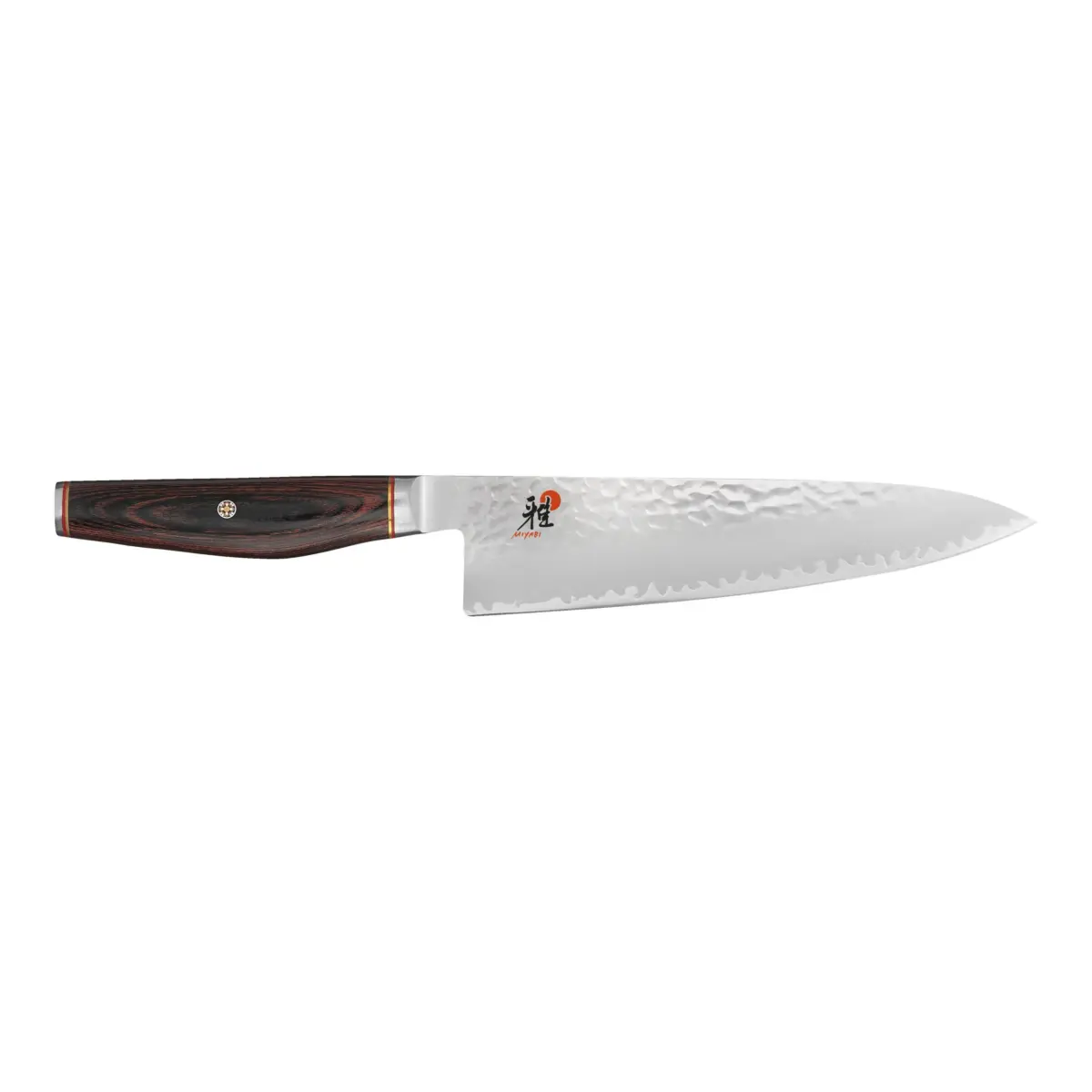 MIYABI Artisan 8-inch Chef's Knife
Side-by-side comparison
| Product | Editor score | Steel | Build | Handle | Care |
|---|---|---|---|---|---|
| ZWILLING Pro 8-inch Chef's Knife | 8.9 Very good | Special-formula high-carbon stainless, FRIODUR | Forged single piece, full tang | Triple-riveted, curved bolster | Dishwasher safe, hand wash recommended |
| Henckels Pakka 8-inch Chef's Knife | 8.2 Very good | German stainless steel | Fully forged single piece | Pakkawood | Hand wash only |
| MIYABI Evolution 8-inch Chef's Knife | 8.4 Very good | FC61 fine carbide, Rockwell 61 | Thin Japanese profile, Honbazuke honed | Triple-riveted POM | Not stated in listing |
| ZWILLING Gourmet 8-inch Chef's Knife | 8.4 Very good | Special-formula high-carbon stainless, FRIODUR | Precision-stamped single piece, full tang | Triple-riveted | Dishwasher safe, hand wash recommended |
| MIYABI Artisan 8-inch Chef's Knife | 8.6 Very good | SG2 (MC63), 63 Rockwell | Tsuchime finish, 9.5-12° edge | D-shaped Cocobolo Rosewood Pakkawood | Hand wash only |
How to choose a chef's knife
The 8-inch chef's knife does more work than every other blade in the block combined, so choose it for the way you cut rather than for the name on the box.
German or Japanese blade style
German-style blades are thicker, with a pronounced curve along the belly that suits a rocking motion, where the tip stays on the board and the heel rises and falls. The steel is tougher and more forgiving, so an occasional twist against a bone does little harm. Japanese-style blades are thinner and harder. They pass through onions and fish with less pressure and hold an edge longer, but they reward a push or pull cut and can chip if misused. Our German vs Japanese guide covers the trade-off in more depth.
Forged or stamped
Forged knives are shaped from a heated block of steel, which usually leaves a bolster at the heel and more weight behind the edge. Stamped knives are cut from sheet steel, so they are lighter and quicker to move. Neither is automatically better. A forged knife like ZWILLING Pro feels planted on dense vegetables, while the stamped ZWILLING Gourmet suits cooks who prep for long stretches.
Handle shape and grip
Most trained cooks hold a chef's knife with a pinch grip, thumb and forefinger on the blade just ahead of the handle. A bolster that leaves room for those fingers, as ZWILLING Pro's curved one does, makes that grip more comfortable. Handle material matters less than shape, so look for a handle that fills your palm without forcing your fingers apart.
Care and sharpening
Every knife here lasts longer if it is washed by hand, dried straight away and kept off glass or stone boards. German knives respond well to regular honing on a steel between sharpenings. Very hard Japanese blades are better kept on a whetstone, since a honing steel or a pull-through sharpener can damage a fine, hard edge. If you are torn between the two styles, our ZWILLING Pro vs MIYABI Evolution comparison lays out who suits which.
How we picked
We looked only at 8-inch chef's knives that ZWILLING, Henckels and MIYABI sell through Zwilling's US stores, with one listing per knife, so sets and other lengths are left out. For each knife we read the brand's specifications for steel, hardness, construction, handle and care, and confirmed it was in stock at the brand's store at the listed price. The picks were then chosen to cover different cooks: an all-rounder, a budget forged knife, two Japanese blades and a lighter German option. These rankings come from specs and brand information, not from lab scores.
FAQ: the best chef’s knives
Is an 8-inch chef's knife the right size?
For most home cooks, yes. Eight inches is long enough to cross a large onion or half a cabbage in one stroke and short enough to control on an ordinary cutting board. Cooks with small hands or a narrow counter sometimes prefer a shorter blade, while people who break down a lot of large produce might want something longer.
Can these knives go in the dishwasher?
ZWILLING lists the Pro and Gourmet as dishwasher safe but recommends hand washing. Henckels Pakka and MIYABI Artisan are hand wash only, and the MIYABI Evolution listing gives no dishwasher rating. Hand washing is the better habit for any good knife, because the edge knocks against racks and the heat and detergent are hard on handles.
Do Japanese knives need special sharpening?
Harder blades like the MIYABI Evolution and Artisan keep their edge longer, but they are best sharpened on a whetstone at the fine angle they left the factory with. A pull-through sharpener designed for German knives can grind away too much steel or leave a ragged edge. If you would rather not learn stone sharpening, a professional service is a good option.
Why does a curved bolster matter?
The bolster is the thick section where blade meets handle. On many forged knives it runs straight down to the heel, which crowds the pinch grip and blocks sharpening at the back of the edge. ZWILLING Pro's bolster slopes back on a curve so thumb and forefinger can rest on the blade, which the brand says improves precision, safety and comfort.