

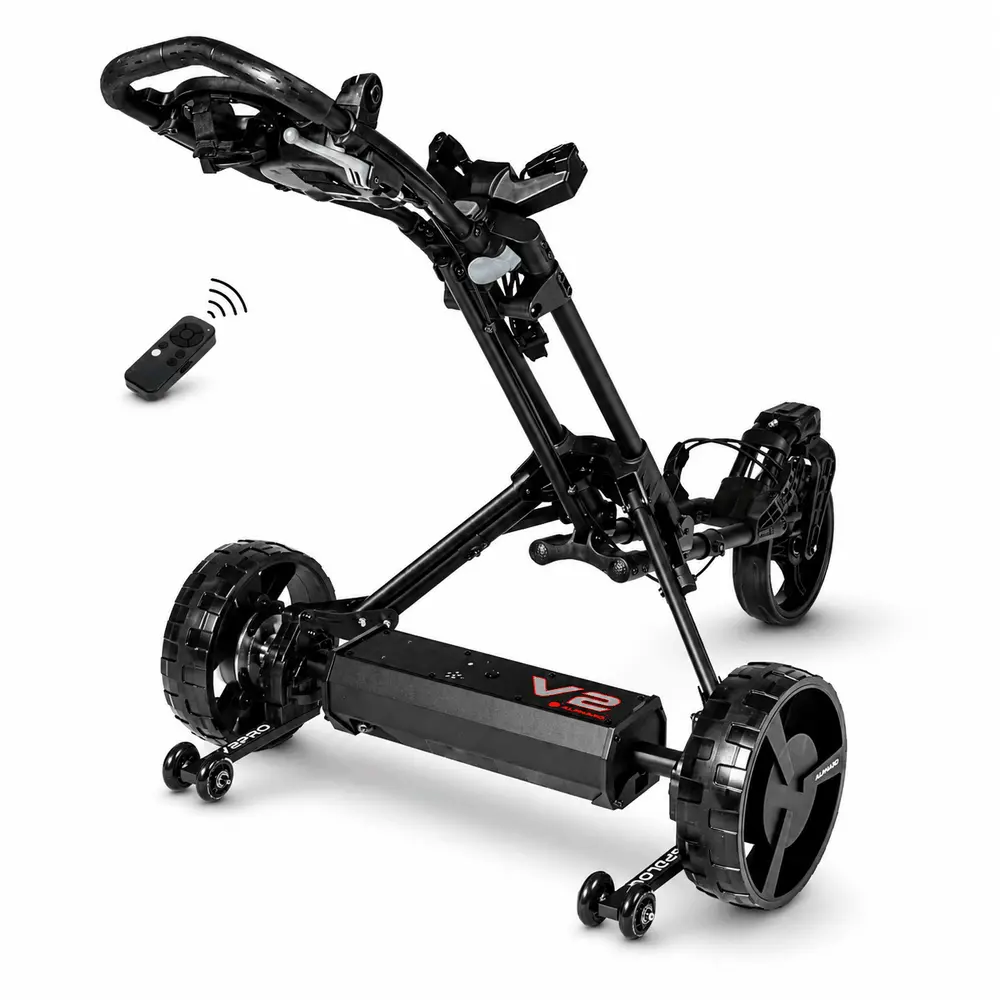
Every walking golfer has to decide how the clubs get around the course. You can carry them, push them or let a motor do the work. Each choice changes how you feel on the back nine, what fits in your car and how much you spend. This guide sets out the trade-offs so you can pick the one that matches your golf.
Key insights
- Alphard V2Pro + Omni Cart: Remote control with phone app backup
- Alphard Club Booster V2Pro: Fits almost all popular push cart brands, per Alphard
- Alphard V2Pro + Omni Cart + Sidekick: Follow mode from either side or from behind
Carrying: light, simple and hard on the shoulders
A stand bag with two straps is the lightest setup and costs nothing beyond the bag itself. It goes anywhere, from steep banks to narrow paths, and it is the fastest way to play when the course is quiet.
The cost is physical. A full bag carried for 18 holes loads the shoulders and lower back, and that fatigue can show up in your swing late in the round. Carrying suits younger, fit golfers, short courses and nine-hole evenings better than long, hilly rounds.
Push carts: weight off your back, effort in your arms
A manual push cart moves the bag's weight onto wheels. Your shoulders get a break, and you gain space for a drink, an umbrella and a scorecard. Most fold flat enough for a car trunk.
You still have to push. On flat courses that is barely noticeable, but on steep climbs a loaded cart takes real effort, and on downhill slopes you are holding it back. Alphard Golf's listings cite a study on the PGA Tour website in which the same golfers scored 45 carrying, 43 riding and 40 with a push cart over nine holes. It is the brand's figure to quote, but it matches the common view that walking without a load leaves more energy for golf.
Electric caddies: the motor does the pushing
An electric caddy adds a motor and a battery to a cart. Remote-controlled models roll ahead or beside you while you steer with a handset, and follow-mode models track you with no steering at all. Alphard's Club Booster V2Pro, for example, uses a remote with a phone app backup, and its Sidekick bundle adds a follow mode.
The benefits grow with the hills. Look for downhill speed control, an automatic parking brake and anti-tip wheels if your course has slopes, since a heavy cart rolling away is the main risk with any motorized trolley.
Where to start
| Role | Model | Price | Why | Buy |
|---|---|---|---|---|
| Best for most walking golfers | Alphard V2Pro + Omni Cart | $997 | Our first pick for walkers who want a complete remote caddy. | Check price |
| Best for converting a cart you own | Alphard Club Booster V2Pro | $849 | Motorizes a push cart you already own with model-matched brackets. | Check price |
| Best hands-free option | Alphard V2Pro + Omni Cart + Sidekick | $1,249 | Adds follow mode for golfers who want their hands free. | Check price |
Batteries, charging and range
Battery range is the number to check first on any electric caddy. Alphard guarantees 18 holes for the V2Pro under warranty and says it can last up to 27 depending on conditions, with a charge time of about three to four hours from a wall outlet.
Hills, wet grass and a heavy bag shorten range on any caddy. If you often play 27 or 36 holes in a day, look for a spare battery option or plan to charge between rounds.
Storage, lifting and transport
A stand bag needs nothing more than a hook in the garage. A push cart folds to a flat package. An electric caddy adds a drive unit and battery: Alphard's V2Pro weighs 19 lbs plus a 4 lb battery, which you lift into the car on top of the cart frame.
Measure your trunk before you buy, and think about who will be lifting it. For many golfers that lift is the deciding factor, more than the price.
Matching the option to your golf
- Short, flat or nine-hole rounds: carry a light stand bag.
- Regular 18-hole walker on gentle terrain: a manual push cart covers it.
- Hilly course, long rounds or a sore back: an electric caddy with downhill control and a parking brake.
- Already own a good push cart: convert it with a unit such as the Club Booster V2Pro rather than replacing it.
FAQ
Are electric caddies allowed on all courses?
Most courses that allow push carts also allow electric ones, but rules vary. Some restrict carts of any kind near greens and tees, and a few limit them when the ground is waterlogged. Check with the pro shop before your first round, especially at a course you have not played.
Is an electric caddy cheating on exercise?
No. You still walk the full course, which is where most of the exercise comes from. The caddy only removes the load of pushing or carrying, so you get the walk without the strain on your shoulders and back. Many golfers find they walk more rounds once the load is gone.
Should I convert my push cart or buy a new electric caddy?
If your push cart is sturdy, folds well and comes from a popular brand, converting it is usually the better value, because you pay only for the drive unit and brackets. If the cart is worn, wobbly or hard to fold, a complete bundle avoids pairing a new motor with a tired frame.
What about riding in a golf cart instead?
Riding is quicker and easier on the legs, but you lose the walk and spend a lot of the round sitting. Some golfers find getting in and out of a cart all day harder on the back than walking. Many courses also charge for riding carts on each round.