The short answer
- On paper it is a 4,096Wh battery with a 4,000W inverter, and testers found the headline numbers largely hold: a 3,650W load ran for an hour at about 89% efficiency.
- The weak spots are weight (just over 113 pounds), occasional resets that needed a manual restart, and a pass-through limit one long-term tester measured at about 1,800W.
- It suits a household backing up a few circuits or an RV with big loads, but the long-term tester would not rely on it alone for critical, unattended backup.
You are standing in your garage with a tape measure, deciding where a backup power unit will live: next to the electrical panel, or somewhere you can roll it out to the driveway when the lights go out.
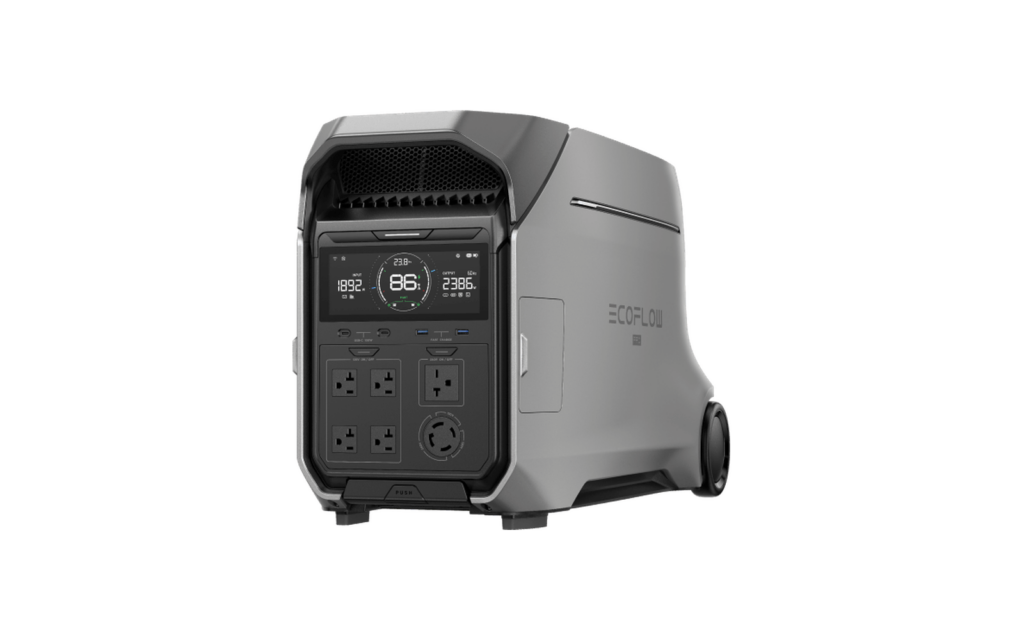
The specification, and what it leaves out
Spec check. Source: EcoFlow and its testers, checked June 2026
| Model | Claimed figure | What the number does not tell you |
|---|---|---|
| Capacity | 4,096Wh | Stored energy, not runtime: how long it lasts depends on the load and on conversion losses. |
| Output | 4,000W at 120V or 240V | The two voltages cannot run at the same time. |
| Surge | 8,000W rating | One test handled 5,100W for nearly a minute, then shut down as loads neared 6,000W. |
| AC charging | 2 hours 20 minutes, advertised | One test measured 2 hours 54 minutes, and the display sat at 2 minutes remaining for a long stretch. |
| Cycle life | 80% capacity after 4,000 cycles | A maker’s figure, not independently measured in the sources quoted. |
How the headline numbers held up
The Solar Lab ran a sustained 3,650W load for 60 minutes, which works out to about 89% efficiency against the 4,096Wh rating, and found it is not designed to handle prolonged surges. A long-term tester put it through real use for about five weeks, including a dinner stop where a microwave, a toaster oven and an air conditioner together pulled about 4,000W without a hitch, and used a second battery to reach 8kWh, which ran an older, inefficient air conditioner for about 9 hours.
Where the sources disagree on pass-through
Where sources disagree
EcoFlow
A maximum continuous output of 4,000W, even during pass-through charging.
CleanTechnica
Plugged into the grid, output was limited to about 1,800W, because input and output are not independent.
Our read
The two accounts cannot both describe the same situation. The 1,800W figure matches the unit’s AC input rating, and it came from a long-term tester who hit the limit with an air conditioner. For a home that stays plugged into the grid, we would plan around 1,800W while charging and treat 4,000W as an off-grid or outage number.
Reliability: the resets
The same long-term tester, who was given the unit by the maker and says so, had to reset it three times in five weeks. Twice it warned of electrical shorts and shut off its output, although wiring inspections found no shorts, and once it drained itself without drawing on the second battery. The fix each time was to disconnect all inputs, switch it off and hold the power button for ten seconds. The tester still recommends the unit for most buyers, but would avoid it for critical, unattended backup, for example anything where an animal’s safety depends on it running while nobody is there to reset it.
Size, weight and home use
TechRadar puts the weight at just over 113 pounds and notes a telescoping handle, rugged wheels and an IP65-rated battery, and says it works as a UPS with a 10 ms switchover for critical appliances. It also says that backing up a whole house through standard outlets needs additional pieces to wire the unit in. The maker lists a 5-year warranty (three years standard plus two on registering in its app) and says capacity can be expanded from 4 to 48kWh.
Who should buy what
A household backing up a few circuits
A fit on paper: 4,000W output and a fast UPS-style switchover, with the pass-through limit in mind. Whole-house backup needs extra wiring.
An RV or camper with big loads
The long-term tester ran air conditioning, an induction range and an oven off it, and recommends it for camping and RV use.
Someone who needs unattended, critical backup
A reason for caution: the long-term tester would not stake critical backup on a unit that sometimes needs a manual reset.
Someone who wants to carry it often
At just over 113 pounds, the wheels help, but this is a rolled appliance rather than a portable camping unit.