The short answer
- Most CPAP machines draw 30 to 60 watts, and heated humidifiers or tubing push that to 90 to 120 watts, so one 8-hour night needs roughly 240 to 960Wh.
- How the machine is powered matters as much as the battery: one camper drained a small station overnight with the humidifier on, then used about 16% a night with a DC adapter and the humidifier off.
- Size the battery from your own machine’s rated power, multiply by nights, and keep generous margin and a backup plan, because this is medical equipment.
The power goes out at 10 p.m. in the middle of winter. The house falls silent, including the machine you rely on to sleep, and you start wondering what size of battery would have kept it running until morning.
What a CPAP actually draws
Enticare, a supplier of CPAP gear, says most machines use 30 to 60 watts in normal operation, with fewer features meaning less power. Heated humidifiers or heated tubing can raise that to 90 to 120 watts, while travel CPAP models sometimes draw under 20 watts. Hart Medical Equipment gives a slightly different range, 30 to 90 watts depending on the model and features. The ranges overlap, and the lesson is the same: the humidifier is the big variable.
Over an 8-hour night, 30 watts is 240Wh and 120 watts is 960Wh. Your own machine will sit somewhere inside that span, and its label or manual is the number to trust.
How you power it changes the answer
One camper’s account on I Heart Pacific Northwest shows how large the gap can be. On a first trip, the camper plugged the machine’s own power supply into a small station’s AC port and left the humidifier running; by morning the battery was nearly empty, with 3% left. After switching to a DC adapter, turning the humidity to 0 and swapping heated tubing for an unheated hose, the same station had 84% left after one night, 68% after two and 52% after three, so about 16% per night.
A review on Wander Woman, which tested a compact station with a humidified CPAP setup, found it ran the machine for approximately six hours on a full charge. The humidifier, it notes, uses significantly more power than a basic setup. Together the two accounts say the same thing: the same battery can last one night or several, depending on settings.
A sizing method you can repeat
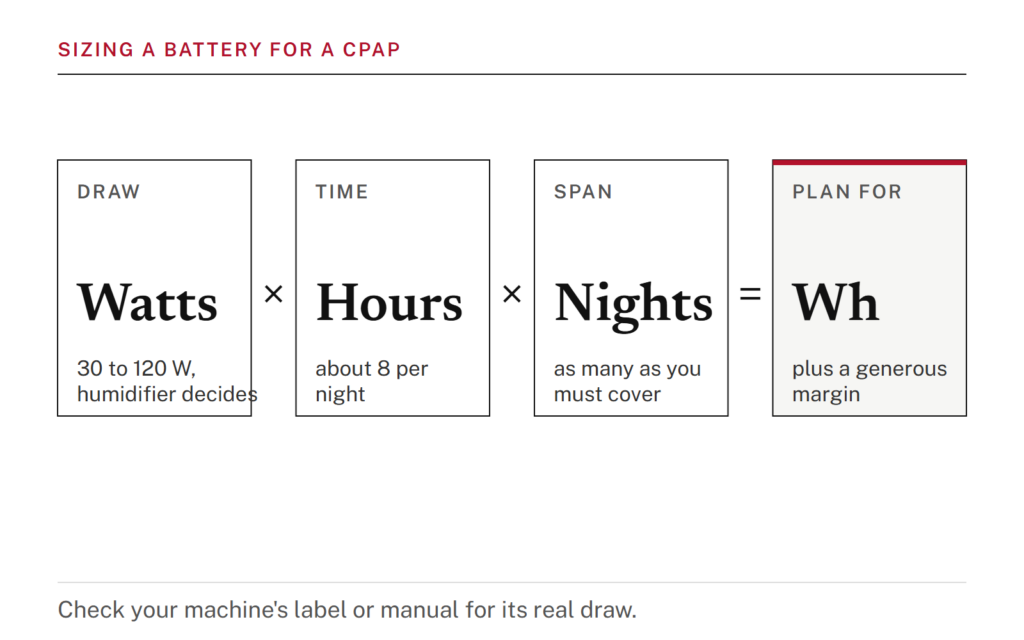
As our watt-hours guide explains, energy is watts multiplied by hours. For a CPAP:
- Find your machine’s power draw in watts from its label or manual, and note whether the humidifier is included in that figure.
- Multiply by the hours you sleep and the number of nights you need to cover. A 60W setup for 8 hours over 2 nights is 60 × 8 × 2 = 960Wh.
- Add a margin for conversion losses and cold weather, and more if the therapy cannot safely be skipped.
- Check that the station can supply the machine’s connection type, and prefer a DC output if the machine supports it, since the DC setup lasted longest in the example.
Station or dedicated CPAP battery?
Enticare lists three options: portable power stations, DC power supplies for vehicle or battery packs, and battery backups made for CPAP machines. The camper above compared a travel CPAP with a compatible battery unit, at around $1,200 for both, against a small station with a list price of $299.99 that weighs just over 8 pounds. A station can also run phones and lamps, while a dedicated battery is built around the machine.
A note on care
Nothing here is medical advice. Check your device’s manual for approved power sources, and ask your sleep provider about backup power, especially if you depend on therapy every night.